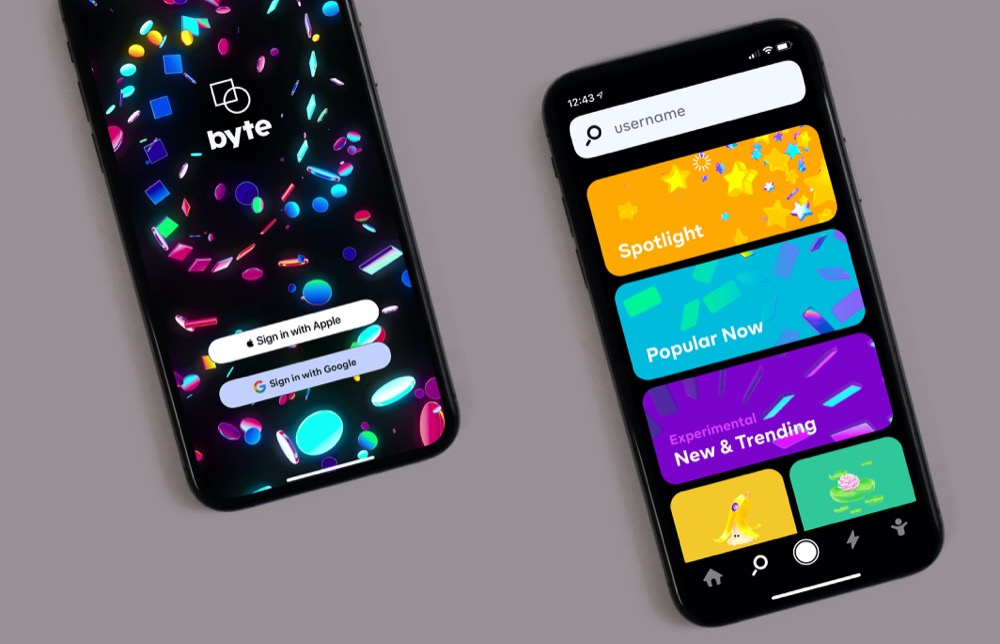

In the third Quarter of 2020 Apple’s App Store made double what Google’s Play store made.
With over 30 Billion app installs Apple’s App Store saw consumers spending around $30 billion in total according to the leading App Store analytics firm.
App stores have seen sustained and expanding growth in the last couple of years with more and more companies launching App store / Launcher store models.
In-app purchases, premium apps, & subscriptions totaled $19 billion worldwide on Apple’s App Store which is twice the amount brought in by Google Play, that is despite the fact that Google Play had three times as many app installs with Apple having 8 billion app installs and Google Play having 28 billion installs.
This shows consumers’ willingness to pay for quality content over trying many different free apps, Indeed I myself on Android devices have found myself trying three or more different apps before I find the one that works best for my need and then within a year or so I find that app is no longer available.
Whereas on the Apple App Store I have had to try fewer apps before I have found the one I need.
And have often been happy to then upgrade for add free versions or extra features, One App that offers a premium version I have been paying $7 a year for over the last 12 years.
I’ve had no need to look for a better alternative as this premium app does exactly what I want, and it is updated yearly so works with whatever iOS device I want to use it with.
Game apps have seen the highest earnings made on App stores across all platforms, with Apps like TikTok , Tinder, WhatsApp, Instagram, & Facebook taking both the largest number of installs and highest earnings.
As we discussed earlier in our article about the possibility of a third party App Store on iOS, these vast revenue’s running through Apple’s accounts are starting to attract derision and antitrust claims from developers and Governmental bodies alike.
And the fact Apple is now making double what its main competitor in the App store market is making will only add to the pressure on Apple to ease its tight grip on iOS app installs.
Analysts from App Store analytics firms are predicting towards the end of 2020 home screen customisations such as those introduced in iOS 14 will see significant growth. See our article on iOS 14 customisation.
This market could be very similar and maybe even more lucrative than the in-game purchases being made which allow the game players to simply change the colour of an object in game or gives them access to premium emotes and weapon skins. All of which are very cheaply priced and are mostly cosmetic changes within the game and so easy to implement.
AI Usage Transparency Report
Pre-AI Era · Written before widespread use of generative AI tools
AI Signal Composition
Score: 0.0 · Low AI Influence
Summary
With over 30 billion app installs, Apple's App Store has seen significant consumer spending. According to the leading App Store analytics firm, this translates to a total of approximately $30 billion spent by users. This figure highlights the vast scale and commercial impact of the App Store on the mobile ecosystem.
Related Posts
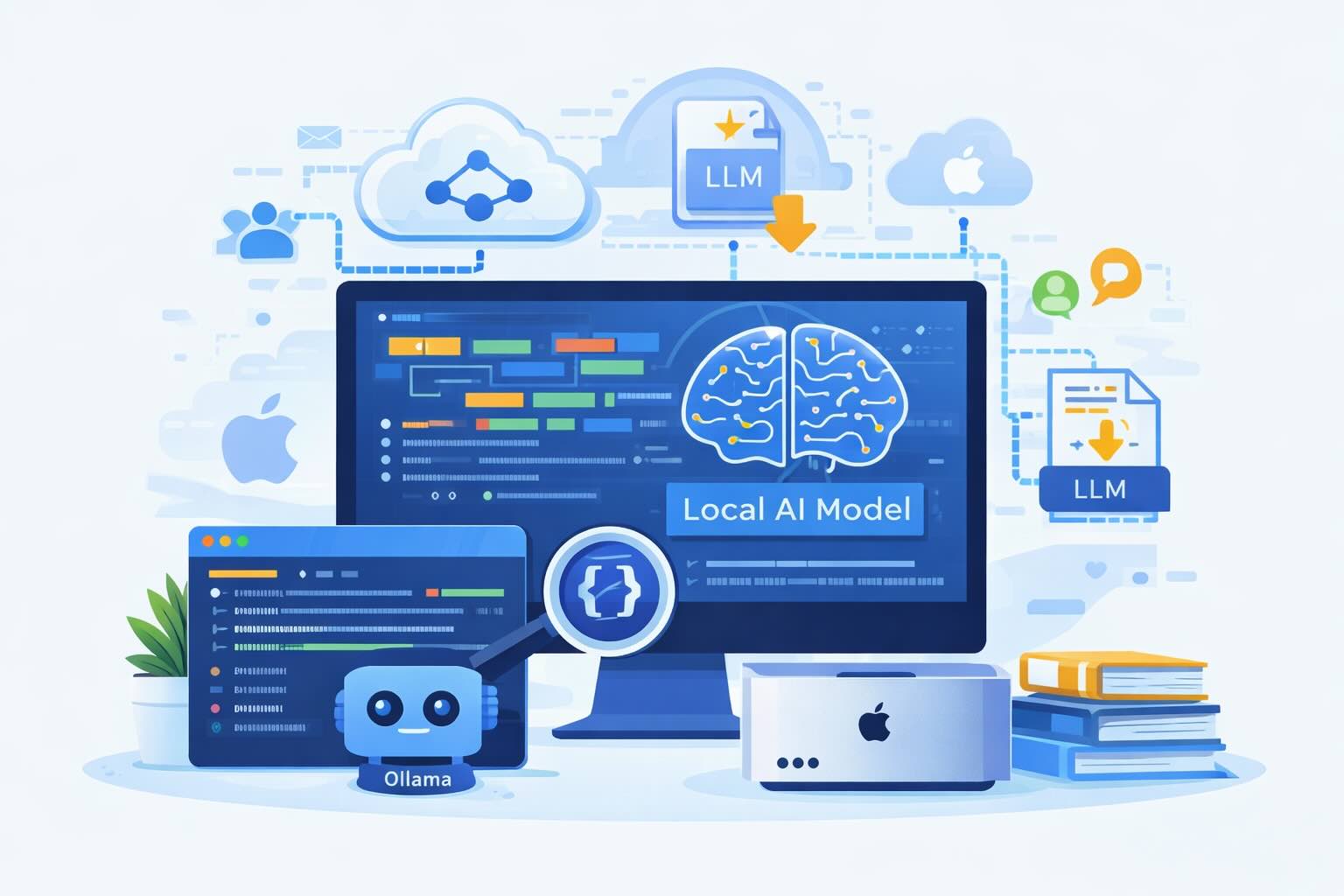
Setting up Ollama on macOS
Recently, after some bad experiences with OpenAI's ChatGPT and CODEX, I decided to look into and learn more about running local AI models. On its face it was intimidating, but I had seen a lot of people in the MacAdmins community posting examples of macOS setups, which really helped lower the bar for me both in terms of approachability and just making me more aware of the local AI community that exists out there today.
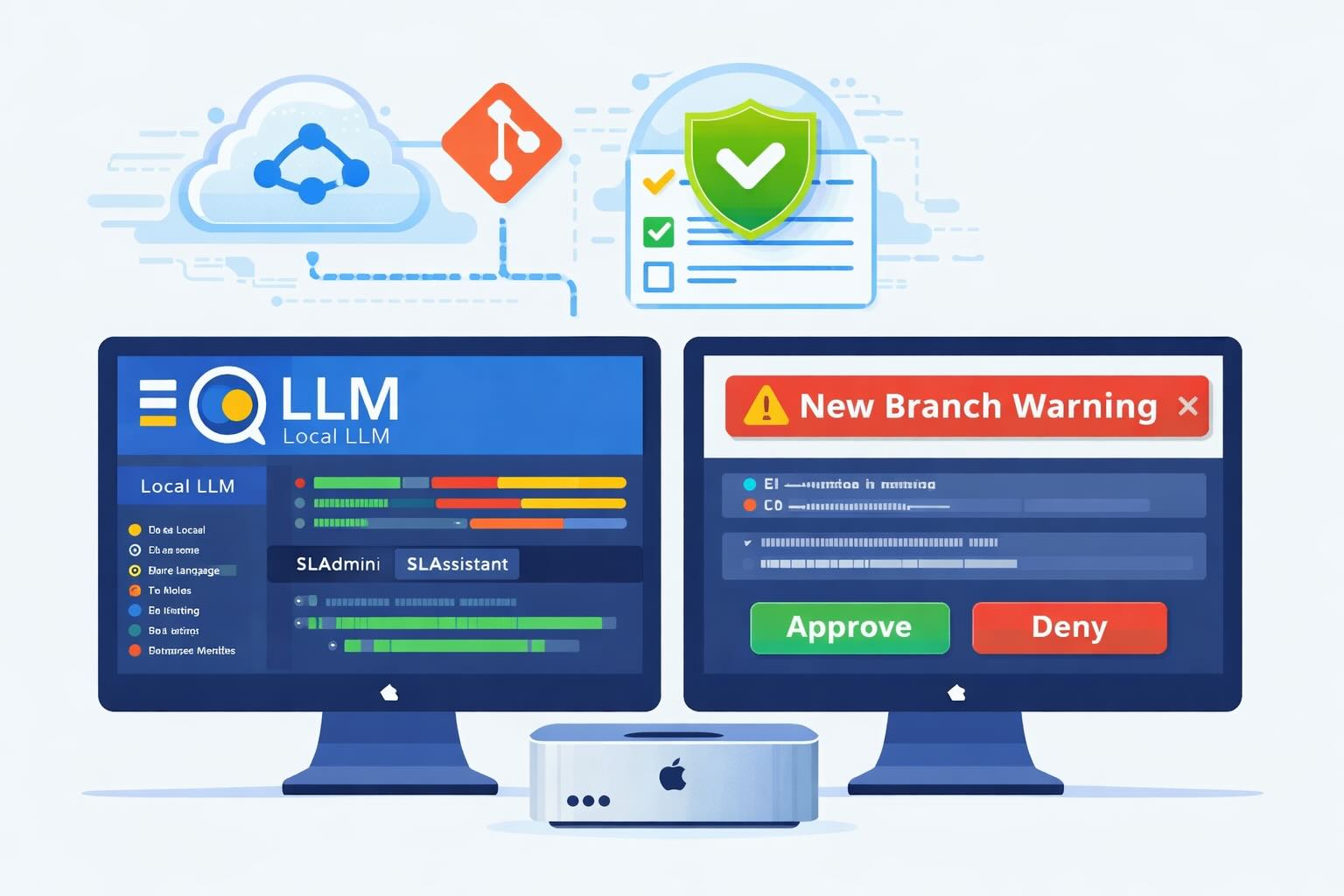
AI Agent Constraints and Security
I really feel like in this era of AI it's essential to write about and share experiences for others who are leveraging AI, especially now that AI usage seems almost ubiquitous. Specifically, when it comes to AI in development and the rapid growth of AI-driven automations in the IT landscape, I believe there's a need for open discussion and exploration.
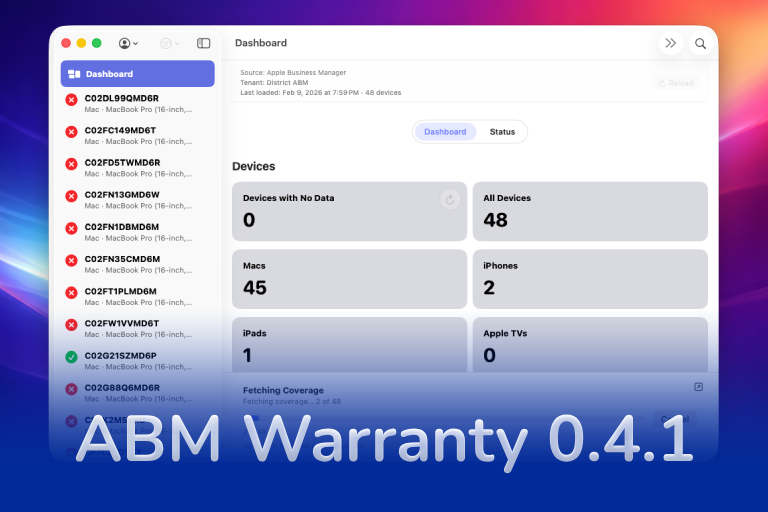
ABM Warranty 0.4.1
The 0.4.x release series for ABM Warranty is focused on operational scale. The earlier 0.3 releases were about trust, correctness, and stabilizing the foundation. Version 0.4.1 builds directly on that work by making the app more practical for consultants, internal IT teams, and managed service providers who need to support multiple environments without losing isolation, control, or visibility. This includes improvements to user interface and workflow, as well as enhanced reporting capabilities to help these users manage their workflows more efficiently.
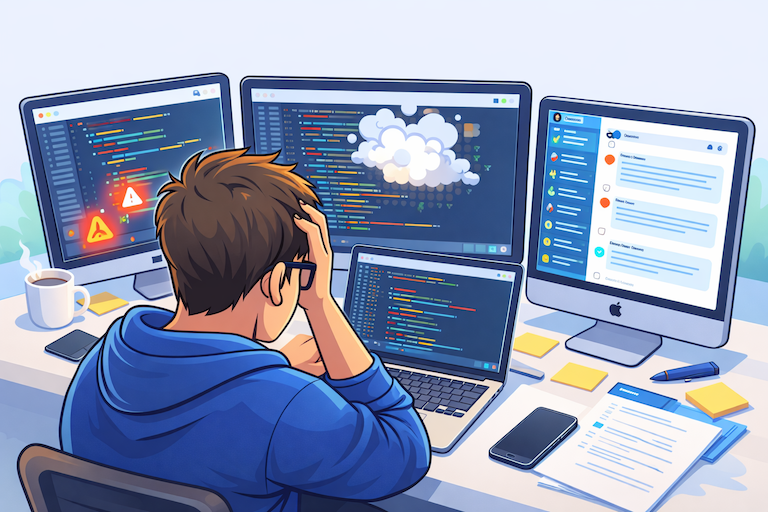
Vibe Coding with Codex: From Fun to Frustration
So there I was, a typically day, a typical weekend. As a ChatGPT customer, I had heard good things about Codex and had not yet tried the platform. To date my experience with agentic coding was simply snippit based support with ChatGPT and Gemeni where I would ask questions, get explanations and support with squashing bugs in a few apps that I work on, for fun, on the side. There were a few core features in one of the apps I built that I wanted to try implementing but the...
The warranty dashboard Apple doesn’t provide… yet
Download ABM Warranty
Why Apple Fleet Risk Isn’t a Security Problem—Until It Is
Security and risk are often treated as interchangeable concepts in modern IT environments, but they are not the same discipline. Security focuses on controls, enforcement, and prevention. Risk management, by contrast, is concerned with likelihood, impact, and consequence across operational, financial, and organizational domains. Frameworks such as those published by NIST make this distinction explicit: risk assessment is not a technical exercise, but a business one. Technology informs risk decisions, but it does not define them.
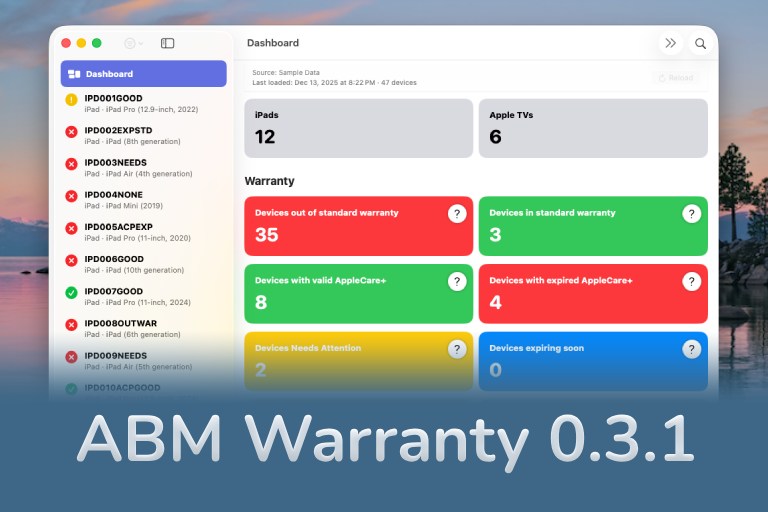
ABM Warranty 0.3.1
The 0.3.x release series for ABM Warranty is about tightening guarantees. Where earlier releases focused on surfacing data and making long-running operations observable, 0.3.x focuses on ensuring that what you see is complete, consistent, and safe to trust—particularly as the app is used in larger, slower, and more varied environments. This shift in focus aims to provide a more reliable foundation for users who require higher levels of assurance from their warranty management system.
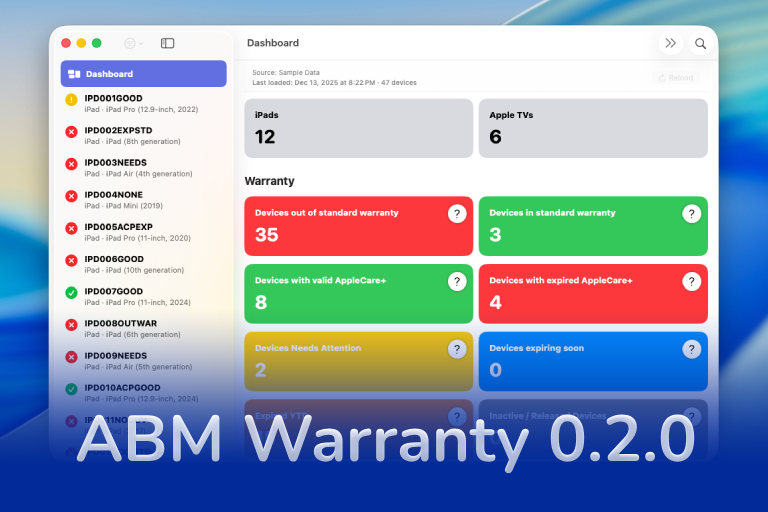
ABM Warranty 0.2.0
ABM Warranty 0.2.0 is a feature release focused on visibility, safety, and scale. This version does not change what ABM Warranty is meant to be, but it significantly improves how the app behaves under real-world conditions—large device counts, API throttling, long-running imports, and the kinds of failure modes Apple IT admins actually encounter. The improvements in this release are designed to make the app more reliable and efficient, allowing it to handle complex scenarios without breaking or becoming unresponsive.
Running a Beta Program: Lessons Learned
Shipping software in isolation is comforting. You control the inputs, the environment, and the narrative you tell yourself about how things work. The moment you invite other people in—especially people who don’t share your assumptions—you lose that comfort. You also gain something far more valuable. Running a public beta for ABM Warranty through Apple’s TestFlight program forced me to confront that tradeoff head-on, and it fundamentally changed how quickly and confidently the app matured.
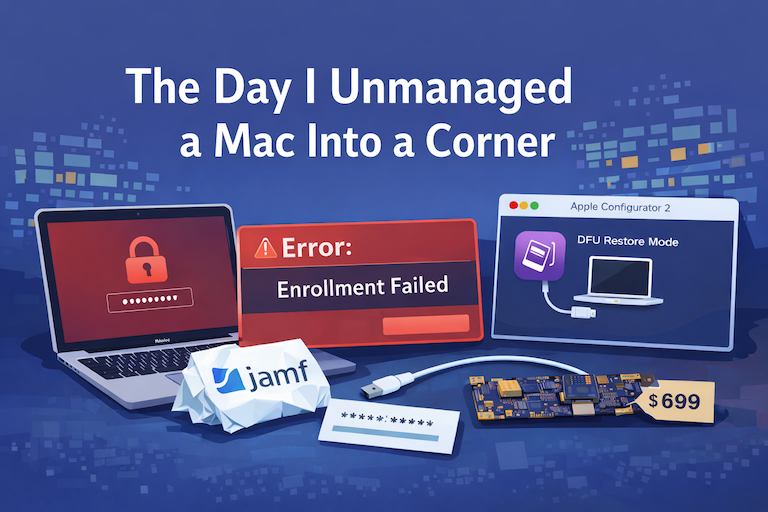
The Day I Unmanaged a Mac Into a Corner
There are a few kinds of mistakes you make as a Mac admin. There are the ones that cost you time, the ones that cost you sleep, and then there are the ones that leave you staring at a perfectly good laptop thinking, “How did I possibly make this *less* manageable by touching it?” These mistakes often stem from a lack of understanding or experience with macOS, but they can also be the result of rushing through tasks or not taking the time to properly plan and test.