
Security and risk are often treated as interchangeable concepts in modern IT environments, but they are not the same discipline. Security focuses on controls, enforcement, and prevention. Risk management, by contrast, is concerned with likelihood, impact, and consequence across operational, financial, and organizational domains. Frameworks such as those published by NIST make this distinction explicit: risk assessment is not a technical exercise, but a business one. Technology informs risk decisions, but it does not define them.
Many technicians and administrators are exposed to risk primarily through mitigation techniques — hardening systems, applying controls, closing gaps — rather than through formal risk assessment processes. They are asked to reduce risk, but rarely invited to help define it. In younger organizations especially, risk is often assessed informally, if at all, and assumptions replace structured analysis. Apple fleets are no exception. As these environments mature, scale, and become more distributed, the gap between security controls and true operational risk becomes increasingly visible. This article explores where that gap exists in Apple fleet management, and why risks that start outside the security domain often end there.
Apple fleets are often described as “secure by default,” and in many ways that assessment is justified. Platform integrity, hardware-backed security, and modern MDM controls meaningfully reduce large classes of technical risk. Yet security controls and risk management are not the same thing. This distinction is foundational in traditional risk frameworks, including those published by NIST, where risk is treated as an operational and business concern rather than a purely technical one.
In those frameworks, risk is defined by likelihood and impact, contextualized by mission, environment, and consequence. Technical controls influence likelihood, but they rarely address impact or recovery. This is where many mature Apple environments quietly accumulate exposure. Not because they are poorly managed, but because certain risks sit outside the scope of what MDMs are designed to mitigate.
What follows is not a critique of MDM platforms. It is an examination of the operational risks that remain once configuration and compliance are in place.

Support Indie Development
These apps are built in my free time.
I build and maintain these tools as an indie developer outside of client work and day-to-day responsibilities. If you find these apps useful and want to help fund continued development, updates, support, and new releases, you can sponsor the work directly.
Monthly support helps me keep shipping improvements, maintain compatibility, and invest more time into building practical software for the Apple admin and consultant community.
1. Single-Device Dependency
MDMs assume the continued existence of the managed endpoint. Policies, profiles, and enforcement models all presuppose that the device is present, functional, and reachable. From a risk perspective, this creates a single-point-of-failure scenario that is rarely articulated explicitly in fleet strategies.
Traditional risk frameworks emphasize dependency mapping and single-point failure analysis because operational continuity matters as much as preventive control. When an endpoint becomes unavailable—through hardware failure, damage, or loss—the risk materializes not as a security event, but as an interruption to business function. MDMs do not model this dependency; they enforce posture on the assumption that the asset remains intact.
2. Recovery Time and Service Latency
Risk frameworks place significant emphasis on response and recovery. Mean time to recovery, not just prevention, is a core determinant of operational impact. In Apple fleets, recovery often involves logistics, shipping, service availability, and user coordination.
MDMs do not account for regional repair variability, shipping delays, or the operational cost of extended downtime. A device may remain compliant until the moment it fails, at which point configuration state becomes irrelevant. The risk here is not misconfiguration, but the absence of a predictable recovery path, something risk assessments explicitly seek to quantify.
3. User Behavior Under Stress
One of the most consistent findings in risk literature is that human behavior under stress deviates from policy. When users lose access to a primary device, especially in remote environments, they seek continuity first and compliance second.
This leads to predictable outcomes: personal device usage, ad-hoc account access, unmanaged replacements, or insecure data handling. MDM controls do not govern behavior on assets that fall outside management, and no amount of endpoint hardening eliminates this risk. Risk frameworks treat this as a socio-technical problem, not a configuration failure.
4. Asset Lifecycle Drift
Risk assessments assume that assets follow defined lifecycle stages. In practice, Apple devices increasingly outlive traditional replacement timelines due to hardware longevity and performance improvements. This creates lifecycle drift, where devices remain operational but diverge from original planning assumptions.
MDMs do not track or contextualize lifecycle risk. A device can remain compliant indefinitely while accumulating operational exposure related to age, supportability, or repairability. Risk frameworks explicitly call for periodic reassessment as conditions change; static compliance does not satisfy this requirement.
5. Remote Workforce Fragility
Distributed workforces fundamentally change risk posture. Physical proximity to IT resources historically served as an implicit mitigation strategy. Remote fleets remove that buffer entirely.
Risk frameworks emphasize environmental context because controls that work in centralized environments do not translate directly to distributed ones. MDMs enforce configuration remotely, but they do not mitigate the fragility introduced when physical intervention is slow, costly, or unavailable. This fragility often remains invisible until a disruption occurs.
6. Financial Unpredictability
Operational risk includes financial exposure, not just technical vulnerability. Unplanned repairs, emergency replacements, and expedited logistics create cost volatility that affects budgeting and procurement decisions.
NIST-style frameworks treat financial impact as a first-class risk dimension. MDMs do not model cost or financial consequence. When financial pressure intersects with technical failure, organizations may delay remediation or accept risk implicitly, introducing secondary security consequences.
7. Third-Party Handling and Custody Risk
Device repair and logistics introduce third-party custody, even in tightly controlled environments. While configuration controls can limit some attack surfaces, custody itself remains a risk vector.
Disabling interfaces such as USB ports mitigates certain threats, but it does not eliminate risks associated with transport, storage, or handling. Risk frameworks distinguish between control effectiveness and threat elimination; custody risk persists regardless of endpoint posture.
8. Compliance Optics Versus Operational Reality
Passing a compliance check often creates a false sense of security. Compliance indicates alignment with a defined standard, not readiness for disruption or incident response.
Risk management frameworks warn against conflating compliance with resilience. MDM dashboards frequently present binary or score-based views that obscure unresolved operational exposure. This gap becomes apparent during audits, incidents, or executive review, when questions extend beyond configuration state.
9. Organizational Knowledge Gaps
Risk assessments account for organizational continuity, including documentation, process maturity, and personnel change. Apple fleets frequently depend on institutional knowledge that is not encoded in tooling.
When administrators leave or MSP relationships change, assumptions embedded in fleet management practices may be lost. MDMs preserve configuration, not intent. Risk frameworks treat this as an operational risk tied to governance and knowledge transfer.
10. False Confidence From Instrumentation
Dashboards and status indicators are powerful, but they shape perception as much as reality. When instrumentation emphasizes compliance metrics alone, it can create blind spots rather than clarity.
Risk frameworks emphasize continuous evaluation and skepticism of static indicators. A fleet can appear healthy while remaining operationally fragile. This is not a tooling failure; it is a misalignment between what is measured and what actually matters.
Risk Management Is an Operational Discipline
Frameworks like NIST consistently frame risk as a cycle: identify, assess, respond, and monitor. Technical controls support this process, but they do not replace it. Apple MDMs are highly effective at enforcing desired states, yet they are not designed to interpret consequence, prioritize impact, or guide operational decision-making.
Understanding this distinction allows organizations to use MDMs appropriately—without overestimating what they can reasonably mitigate.
Conclusion
Apple fleet risk is rarely a security problem at the outset. It becomes one when operational risks materialize and intersect with security outcomes. Organizations that recognize this early treat fleet management as an operational program rather than a compliance exercise.
This perspective is not about blame or tool selection. It is about aligning modern Apple environments with established risk management principles and acknowledging the risks that exist beyond configuration enforcement. Doing so leads to more resilient fleets, fewer surprises, and better outcomes when inevitable disruptions occur.
References
- NIST Special Publication 800-30 Rev. 1 — Guide for Conducting Risk Assessments
- NIST Special Publication 800-37 Rev. 2 — Risk Management Framework for Information Systems and Organizations
- NIST Special Publication 800-53 Rev. 5 — Security and Privacy Controls for Information Systems and Organizations
- ISO/IEC 27005 — Information Security Risk Management
- Apple Platform Security (Apple User Guide)
- Jamf Learning Hub (Official Technical Documentation)
Ready to take your Apple IT skills and consulting career to the next level?
I’m opening up free mentorship slots to help you navigate certifications, real-world challenges, and starting your own independent consulting business.
Let’s connect and grow together — Sign up here
AI Usage Transparency Report
AI Era · Written during widespread use of AI tools
AI Signal Composition
Score: 0.27 · Moderate AI Influence
Summary
The article discusses the operational risks in Apple fleet management, including single-device dependency, recovery time and service latency, user behavior under stress, asset lifecycle drift, remote workforce fragility, financial unpredictability, third-party handling and custody risk, compliance optics versus operational reality, organizational knowledge gaps, and false confidence from instrumentation.
Related Posts

Introducing Pique - The Game-Changing Quick Look Plugin for Mac Admins
As a Mac admin, I'm always on the lookout for tools that make my life easier and more efficient. Recently, I stumbled upon Pique - a brilliant Quick Look plugin created by Henry Stamerjohann that allows you to view file contents in a syntax highlighted way.

ABM Warranty 0.4.1 Walkthrough: Wrap-Up and Beta
In this final ABM Warranty 0.4.1 walkthrough, I’m wrapping up the last features I had not covered directly in the earlier videos and then focusing on support, community, and the beta program. I also want to show where the support resources live inside the app so you know where to go if you need help, documentation, or a way to send useful feedback. Additionally, I'll be covering some of the key features that were updated since the previous version, including any bug fixes or improvements made to existing functionality.
ABM Warranty 0.4.1 Walkthrough: Managed Preferences
In this part of the ABM Warranty 0.4.1 walkthrough series, I'm focusing on managed preferences and the credential packaging workflow. In the last video, I covered multiple credentials inside the app itself. In this one, I'm showing how to package those credentials so they can be deployed securely through MDM. This process is a crucial step in ensuring that your credentials are properly configured and protected within your organization's mobile device management system.
Low Profile Walkthrough and Review
Today I’m walking through Low Profile, a utility from Nindi Gill that I use when I want to inspect profiles already installed on a Mac and figure out whether those profiles contain issues I need to clean up. The value is that Low Profile gives me a straightforward way to inspect profiles installed on any Mac. This simplicity makes it easy for me to identify and address potential problems, which is especially useful when working with multiple machines or troubleshooting complex profile configurations.
ABM Warranty 0.4.1 Walkthrough: Multiple Credentials
In this part of the ABM Warranty 0.4.1 walkthrough series, I’m focusing on multiple credentials. In the first video, I showed the basic setup and how to add a single credential. Now, I want to explore what happens when I remove a credential, what changes occur when I add more than one, and how the app behaves once there are multiple contexts in play. This will help clarify any potential issues or inconsistencies that may arise with multiple credentials.
QuickPKG Walkthrough and Review
I use QuickPKG when I need to turn an application, DMG, or ZIP file into a package quickly without wasting time in a heavier packaging workflow. This post follows the same path as my video: what QuickPKG is, where to get it, how I run it, what a simple packaging example looks like, and where I think admins need to be careful about potential pitfalls that can arise from using this tool.
ABM Warranty 0.4.1 Walkthrough: Introduction
In this first ABM Warranty 0.4.1 walkthrough, I want to show you what the app actually does before I get into the more specific feature videos. This is the broad introduction. I’m walking through the dashboard, how I think about the warranty cards, how released devices are handled, how the filters work, how to add credentials, where the data is stored locally, and what the logging and security model looks like.
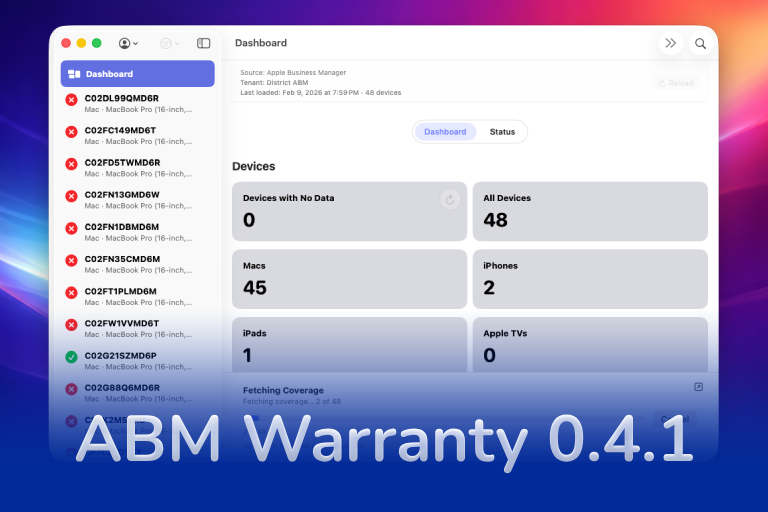
ABM Warranty 0.4.1
The 0.4.x release series for ABM Warranty is focused on operational scale. The earlier 0.3 releases were about trust, correctness, and stabilizing the foundation. Version 0.4.1 builds directly on that work by making the app more practical for consultants, internal IT teams, and managed service providers who need to support multiple environments without losing isolation, control, or visibility. This includes improvements to user interface and workflow, as well as enhanced reporting capabilities to help these users manage their workflows more efficiently.
The warranty dashboard Apple doesn’t provide… yet
Download ABM Warranty
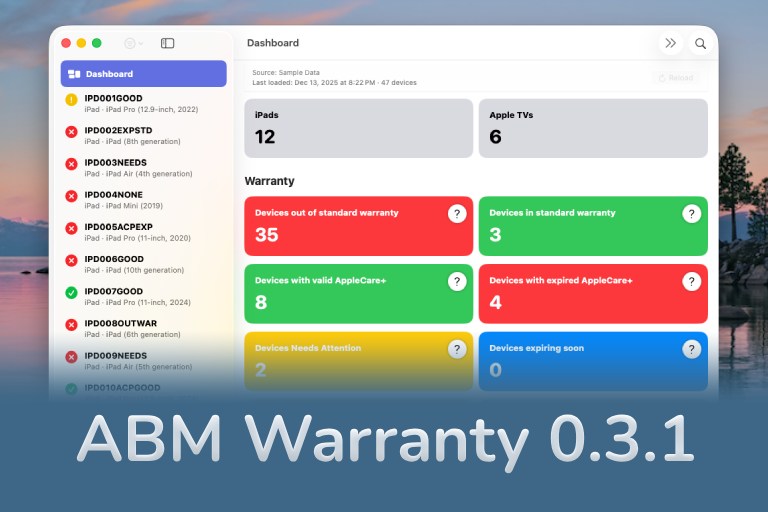
ABM Warranty 0.3.1
The 0.3.x release series for ABM Warranty is about tightening guarantees. Where earlier releases focused on surfacing data and making long-running operations observable, 0.3.x focuses on ensuring that what you see is complete, consistent, and safe to trust—particularly as the app is used in larger, slower, and more varied environments. This shift in focus aims to provide a more reliable foundation for users who require higher levels of assurance from their warranty management system.