

In the fast-paced realm of consultancy, where competition is fierce and innovation is key, finding the delicate balance between competition, collaboration, and cooperation is essential. Today, we embark on a journey to explore the transformative potential of collaboration in the consultancy world.
Understanding the Collaboration Continuum
At the heart of successful collaborations lies the Collaboration Continuum, a spectrum ranging from basic networking to deep, mutually beneficial partnerships. It starts with networking, where information exchange is limited, leading to coordination, cooperation, and finally, collaboration, marked by profound organizational commitment and formal agreements.
The Role of Trust and Abundance Mentality One of the major hurdles in collaboration is the fear of competition and the struggle to trust others within the same niche. However, embracing an abundance mentality can transform this mindset. Recognizing that there’s more than enough business for everyone opens the door to meaningful collaborations. Trust becomes the linchpin upon which successful partnerships are built, fostering an environment of cooperation and shared goals.
Personal Insights: Collaboration in Action
Many successful consultants have discovered that partnering with vendors and companies outside their main focus group can be incredibly fruitful. However, collaborating with consultancies targeting the same clients requires a different approach. Acknowledging the reality that we can’t scale infinitely, and thus, there’s a limit to how much business one can handle, makes it easier to initiate these crucial conversations.
Inspiration from Visionaries
Industry pioneers like Walt Disney emphasized the role of people in turning dreams into reality. In the consultancy world, it’s the relationships, collaborations, and shared visions that breathe life into aspirations, creating thriving businesses. Helen Keller’s words echo this sentiment: “Alone, we can do so little; together, we can do so much.”
The Business Imperative of Collaboration
Studies from McKinsey & Company underscore the business imperative of diverse and inclusive teams. Collaborative environments not only boost productivity but also foster innovation. When consultancies embrace cooperation and build bridges, they create a powerful synergy that benefits everyone involved.
Join the Conversation
The path to successful collaboration in consultancy is multifaceted and dynamic. We invite you to share your experiences and insights. How has collaboration transformed your consultancy endeavors? What challenges have you faced, and how did you overcome them? By joining the conversation, we can learn from one another and collectively elevate the consultancy landscape.
Let’s work together to build a consultancy community where collaboration triumphs over competition, where partnerships are not just a necessity but a source of inspiration, and where every consultant can thrive and reach new heights of success.
Remember, alone we can do so little; together, we can do so much.
AI Usage Transparency Report
AI Era · Written during widespread use of AI tools
AI Signal Composition
Score: 0.17 · Low AI Influence
Summary
The article discusses the importance of collaboration in consultancy, highlighting its transformative potential and the role of trust and abundance mentality in successful partnerships.
Related Posts
Setting up Ollama on macOS
Recently, after some bad experiences with OpenAI's ChatGPT and CODEX, I decided to look into and learn more about running local AI models. On its face it was intimidating, but I had seen a lot of people in the MacAdmins community posting examples of macOS setups, which really helped lower the bar for me both in terms of approachability and just making me more aware of the local AI community that exists out there today.
AI Agent Constraints and Security
I really feel like in this era of AI it's essential to write about and share experiences for others who are leveraging AI, especially now that AI usage seems almost ubiquitous. Specifically, when it comes to AI in development and the rapid growth of AI-driven automations in the IT landscape, I believe there's a need for open discussion and exploration.
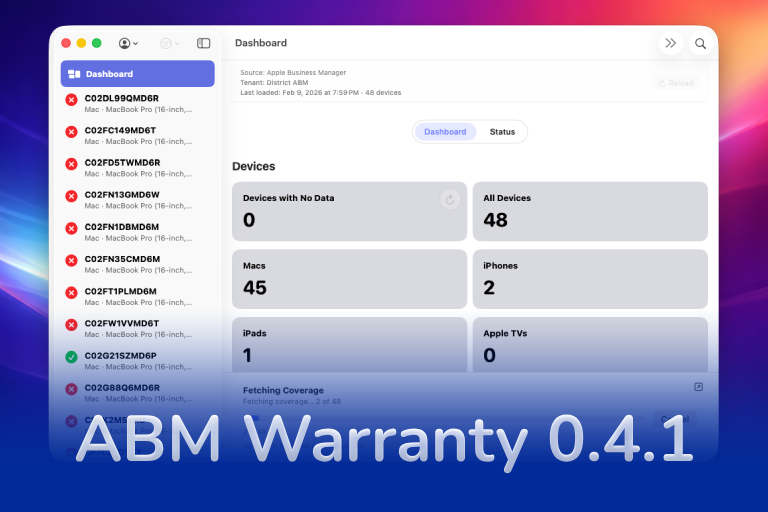
ABM Warranty 0.4.1
The 0.4.x release series for ABM Warranty is focused on operational scale. The earlier 0.3 releases were about trust, correctness, and stabilizing the foundation. Version 0.4.1 builds directly on that work by making the app more practical for consultants, internal IT teams, and managed service providers who need to support multiple environments without losing isolation, control, or visibility. This includes improvements to user interface and workflow, as well as enhanced reporting capabilities to help these users manage their workflows more efficiently.

Vibe Coding with Codex: From Fun to Frustration
So there I was, a typically day, a typical weekend. As a ChatGPT customer, I had heard good things about Codex and had not yet tried the platform. To date my experience with agentic coding was simply snippit based support with ChatGPT and Gemeni where I would ask questions, get explanations and support with squashing bugs in a few apps that I work on, for fun, on the side. There were a few core features in one of the apps I built that I wanted to try implementing but the...
The warranty dashboard Apple doesn’t provide… yet
Download ABM Warranty
Why Apple Fleet Risk Isn’t a Security Problem—Until It Is
Security and risk are often treated as interchangeable concepts in modern IT environments, but they are not the same discipline. Security focuses on controls, enforcement, and prevention. Risk management, by contrast, is concerned with likelihood, impact, and consequence across operational, financial, and organizational domains. Frameworks such as those published by NIST make this distinction explicit: risk assessment is not a technical exercise, but a business one. Technology informs risk decisions, but it does not define them.
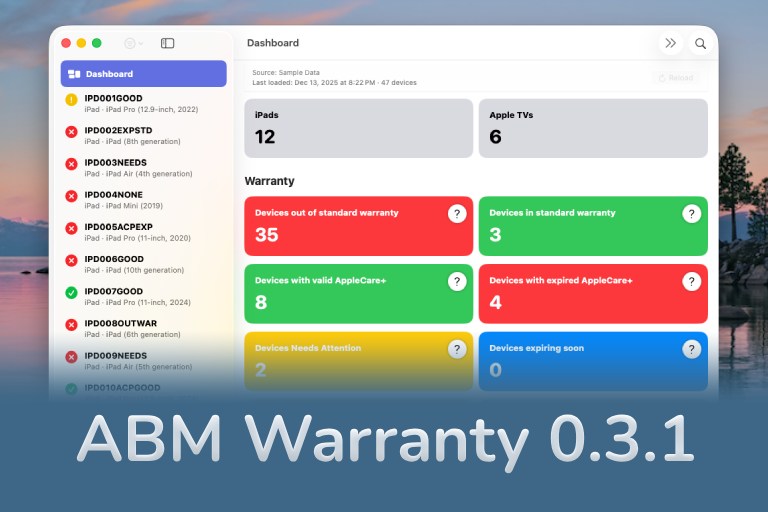
ABM Warranty 0.3.1
The 0.3.x release series for ABM Warranty is about tightening guarantees. Where earlier releases focused on surfacing data and making long-running operations observable, 0.3.x focuses on ensuring that what you see is complete, consistent, and safe to trust—particularly as the app is used in larger, slower, and more varied environments. This shift in focus aims to provide a more reliable foundation for users who require higher levels of assurance from their warranty management system.
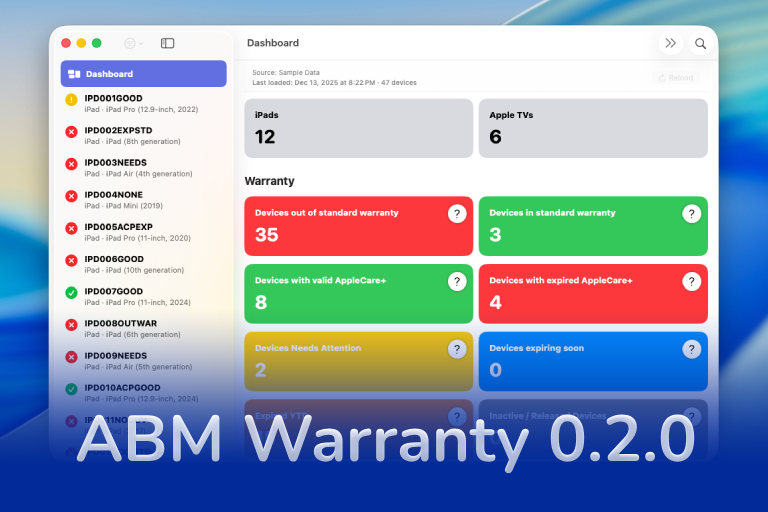
ABM Warranty 0.2.0
ABM Warranty 0.2.0 is a feature release focused on visibility, safety, and scale. This version does not change what ABM Warranty is meant to be, but it significantly improves how the app behaves under real-world conditions—large device counts, API throttling, long-running imports, and the kinds of failure modes Apple IT admins actually encounter. The improvements in this release are designed to make the app more reliable and efficient, allowing it to handle complex scenarios without breaking or becoming unresponsive.
Running a Beta Program: Lessons Learned
Shipping software in isolation is comforting. You control the inputs, the environment, and the narrative you tell yourself about how things work. The moment you invite other people in—especially people who don’t share your assumptions—you lose that comfort. You also gain something far more valuable. Running a public beta for ABM Warranty through Apple’s TestFlight program forced me to confront that tradeoff head-on, and it fundamentally changed how quickly and confidently the app matured.
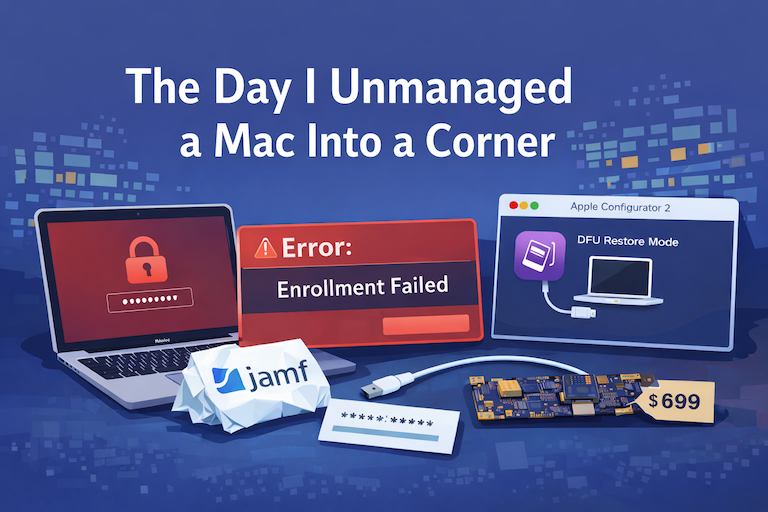
The Day I Unmanaged a Mac Into a Corner
There are a few kinds of mistakes you make as a Mac admin. There are the ones that cost you time, the ones that cost you sleep, and then there are the ones that leave you staring at a perfectly good laptop thinking, “How did I possibly make this *less* manageable by touching it?” These mistakes often stem from a lack of understanding or experience with macOS, but they can also be the result of rushing through tasks or not taking the time to properly plan and test.