
In this part of the ABM Warranty 0.4.1 walkthrough series, I’m focusing on managed preferences and the credential packaging workflow. In the last video, I covered multiple credentials inside the app itself. In this one, I’m showing how to package those credentials so they can be deployed securely through MDM.
The goal here is not just to show that managed preferences exist. I want to show how the full workflow works: how I format the credential data, how the packaging script outputs the deployment files, how the credentials are encrypted, what the user sees when the app detects them, and how ABM Warranty behaves once those managed credentials are imported.
What Managed Preferences Are Doing Here
Managed preferences are the way I can push ABM Warranty configuration down to a Mac through MDM instead of configuring everything manually on the endpoint. In this case, that means pushing managed credential data in a format the app can detect and import.
There are two practical output paths in this workflow:
- a mobileconfig file, which works with MDM platforms that can deploy configuration profiles
- a plist, which works where raw plist preference deployment is supported
That is what makes this feature flexible. I am not tied to only one management tool. If the MDM can push a mobileconfig, this workflow can fit. If the tool can deploy raw plist data, that works too.
Why I Start With Security
Whenever I am building a deployment workflow that involves ABM or ASM credentials, I want the security model to be explicit. This part matters because no one should trust a credential deployment workflow unless it is clear how the secrets are being protected and what the receiving user is actually importing.
The starting point is still the CSV file. That file gives the packager the structured data it needs: the friendly name, the scope, the client ID, the key ID, and the path to the certificate or PEM file tied to each credential set. If I am packaging multiple credentials, each one gets its own row so the output can preserve those boundaries cleanly.
What matters is what happens next. The packager does not simply take that CSV data and write it back out in an MDM-friendly format. It prompts for a passphrase, derives the encryption material from that passphrase, and then protects the credential payload before writing it out.
At a high level, the private-key material is encrypted with AES-256-GCM. The encryption key is derived from the passphrase using HKDF with SHA-256. That matters because I want the output tied to a strong symmetric encryption model, and I want the key derivation to be based on a deliberate passphrase workflow instead of storing reusable key material in the deployment file itself.
Just as important, the passphrase is not stored in the plist or the mobileconfig output. The managed-preferences payload contains protected credential data, but it does not contain the passphrase needed to unlock that data. That means the deployment artifact alone is not enough to silently expose the underlying credential material.
On the receiving Mac, ABM Warranty does not import those credentials automatically behind the user’s back. The app requires explicit user consent to begin the import, and the user still has to provide the passphrase that was used when the payload was created. Only then can the app decrypt the protected credential data and complete the import.
I also built the managed import flow to behave like a one-time import by credential ID. That matters because I do not want the app repeatedly prompting the user to re-import the same managed credentials over and over again every time the preferences are detected. Treating the managed credential as a one-time import by ID prevents noisy re-import loops and keeps the workflow predictable.
Once the credentials are imported, the app can continue treating them as managed credentials in the interface, while the underlying credential lifecycle still stays bounded by the import model and the local security controls. That includes the app’s use of the keychain where appropriate for local handling after import.
That is the real point of the packager from a trust perspective. I can prepare deployable managed credentials without reducing the process to copying plain-text secrets into an MDM payload, and the receiving user still has to explicitly participate in the import before those credentials become active in the app.
The Tools Behind the Workflow
This managed-preferences flow depends on the ABM Warranty managed credential packager and the supporting documentation that explains how to use it.
Resources and sources
If you are the person building these managed credentials, that is where you should start. The workflow depends on that packager and the documented CSV format.
The CSV Format I Use
The script expects the CSV data in a specific format. Each row represents one credential set. If I only have one credential, the file contains one row. If I have multiple credentials, the file contains multiple rows.
The important thing is that the columns stay in the expected order:
- a row identifier
- a friendly name
- a scope (
businessorschool) - the client ID
- the key ID
- the path to the certificate or PEM file
That structure is what lets the script package the data correctly. If the CSV is malformed, the managed-preferences output is not going to be right either.
What I Need Before I Run the Script
Before I run the packager, I need a working Python 3 environment and the required cryptography package installed. That is part of the packaging side of the workflow, not the endpoint side.
The setup looks like this:
pip install cryptography
Once that is in place, I can run the script with a CSV input and choose whether I want plist output or mobileconfig output.
How to Deploy A Single Credential
The script takes the CSV as input and then writes the managed-preferences output in the format I choose. If I am exporting a plist, I point the script to the CSV, define the output type, and provide a name for the output file.
A typical example looks like this:
python3 ABMManagedCredentialPackager.py --csv single.csv --out plist --name singleplist.plist
When I run that, the script prompts me for a passphrase. That passphrase is part of the encryption process. The script uses it to protect the credential data in the generated output.
That means the administrator packaging the credentials is not just generating a file. They are also defining the passphrase that the receiving user will need later when ABM Warranty imports and decrypts the managed credentials.
What the Packager Outputs
Once the script runs, I get the encrypted output file along with a test command I can use locally. That is useful because I do not have to push the preferences through MDM immediately just to see whether they work.
I can test the managed preference on my own Mac first, apply the generated plist locally, quit the app, relaunch it, and verify the exact user experience before I ever deploy the payload more broadly.
That makes the workflow much easier to validate. I can confirm the packager output is correct before I roll it into an MDM deployment.
How to Deploy Multiple Credentials
The workflow also supports more than one managed credential in the same deployment. If I build a CSV file with multiple rows, the output can contain multiple credential sets, and the app will detect and import them together.
The important part is that each credential gets its own row in the CSV. A simple multi-credential CSV can look like this:
id,name,scope,client_id,key_id,pem_path
1,Corp ABM,business,CLIENT_ID_1,KEY_ID_1,/Users/admin/certs/corp_abm.pem
2,School ASM,school,CLIENT_ID_2,KEY_ID_2,/Users/admin/certs/school_asm.pem
That lets me define separate friendly names and separate scopes while still packaging them in one deployable output.
If I want to export that CSV as a plist for a platform like Jamf that can handle raw plist deployment, I run:
python3 ABMManagedCredentialPackager.py --csv combo.csv --out plist --name combo.plist
That is where this feature becomes especially useful. I can push more than one managed context, and ABM Warranty will present those credentials as separate managed entries once the user imports them successfully.
At the same time, the app still keeps the distinction between managed credentials and manually added credentials. I can still add a separate unmanaged credential locally, and that one behaves differently because it was not delivered through managed preferences.
Exporting Single and Multiple Credentials as a Mobileconfig
Plist output is useful when the management platform can write raw preference data directly, which is why it maps cleanly to tools like Jamf. Mobileconfig output solves a different deployment problem: it gives me a standard configuration-profile payload I can upload into MDM platforms that work best with profile-based preference delivery instead of raw plist deployment.
If I need the broadest compatibility across MDM tools, the mobileconfig route is usually the safer default because it packages the managed preferences in the same profile format admins are already used to deploying.
The command looks like this:
python3 ABMManagedCredentialPackager.py --csv single.csv --out mobileconfig --name single.mobileconfig
If I am packaging multiple credentials into one mobileconfig, I use the same idea with the multi-row CSV:
python3 ABMManagedCredentialPackager.py --csv combo.csv --out mobileconfig --name combo.mobileconfig
That gives me two clear deployment paths:
- plist output for tools like Jamf that can handle raw plist deployment
- mobileconfig output for MDMs that prefer configuration profile deployment
What the User Sees After App Relaunch
After the managed preference is applied, I need to quit and relaunch the app so ABM Warranty can detect the new managed credentials. Once the app restarts, it shows a banner telling me that managed ABM credentials were detected and are ready to import.
That is the handoff point between the admin who packaged the credentials and the person receiving them on the Mac. The receiver still needs the passphrase that was used during packaging, because the app needs that passphrase to decrypt and import the managed credentials locally.
If the passphrase is wrong, the import fails. If it is correct, the app imports the credentials and the managed credential appears in the ABM Warranty settings.
What Makes a Credential “Managed”
Once the import completes, the credential shows up in the app as managed. That is an important distinction.
A managed credential is not the same as a manually added credential. If the credential came from managed preferences, the person using the Mac should not be able to delete it the same way they could delete a credential they created manually.
That is intentional. It preserves the management boundary. The administrator controls the deployed managed credential, while the local user can still add their own separate manual credentials if they need to.
Why This Deployment Model Matters
This managed-preferences workflow solves a very specific operational problem: I can prepare ABM Warranty credentials centrally, deploy them through MDM, protect them with an encrypted packaging flow, and still let the receiving Mac import them in a controlled way.
That is a much better workflow than walking people through manual credential entry one machine at a time, especially when I need a more repeatable deployment path.
For me, this is one of the most useful parts of 0.4.1 because it turns credential setup into something I can standardize and deploy cleanly instead of treating every endpoint like a one-off manual setup.

Support Indie Development
These apps are built in my free time.
I build and maintain these tools as an indie developer outside of client work and day-to-day responsibilities. If you find these apps useful and want to help fund continued development, updates, support, and new releases, you can sponsor the work directly.
Monthly support helps me keep shipping improvements, maintain compatibility, and invest more time into building practical software for the Apple admin and consultant community.
AI Usage Transparency Report
AI Era · Written during widespread use of AI tools
AI Signal Composition
Score: 0.25 · Moderate AI Influence
Summary
This walkthrough series focuses on managed preferences and credential packaging workflow in ABM Warranty 0.4.1.
Related Posts

Automating JAMF Pro Email Notifications with SendGrid (Smart Group Driven Workflows)
Modern device management isn't just about enforcing policies—it's about communicating effectively with users at the right time. In JAMF Pro, Smart Groups give you powerful visibility into device state, but they don't natively solve the problem of proactive, automated user communication. Whether you're trying to prompt users to restart their machines, complete updates, or take action on compliance issues, bridging that gap requires a flexible and scalable notification system.

Introducing Pique - The Game-Changing Quick Look Plugin for Mac Admins
As a Mac admin, I'm always on the lookout for tools that make my life easier and more efficient. Recently, I stumbled upon Pique - a brilliant Quick Look plugin created by Henry Stamerjohann that allows you to view file contents in a syntax highlighted way.

ABM Warranty 0.4.1 Walkthrough: Wrap-Up and Beta
In this final ABM Warranty 0.4.1 walkthrough, I’m wrapping up the last features I had not covered directly in the earlier videos and then focusing on support, community, and the beta program. I also want to show where the support resources live inside the app so you know where to go if you need help, documentation, or a way to send useful feedback. Additionally, I'll be covering some of the key features that were updated since the previous version, including any bug fixes or improvements made to existing functionality.

Low Profile Walkthrough and Review
Today I’m walking through Low Profile, a utility from Nindi Gill that I use when I want to inspect profiles already installed on a Mac and figure out whether those profiles contain issues I need to clean up. The value is that Low Profile gives me a straightforward way to inspect profiles installed on any Mac. This simplicity makes it easy for me to identify and address potential problems, which is especially useful when working with multiple machines or troubleshooting complex profile configurations.
ABM Warranty 0.4.1 Walkthrough: Multiple Credentials
In this part of the ABM Warranty 0.4.1 walkthrough series, I’m focusing on multiple credentials. In the first video, I showed the basic setup and how to add a single credential. Now, I want to explore what happens when I remove a credential, what changes occur when I add more than one, and how the app behaves once there are multiple contexts in play. This will help clarify any potential issues or inconsistencies that may arise with multiple credentials.

QuickPKG Walkthrough and Review
I use QuickPKG when I need to turn an application, DMG, or ZIP file into a package quickly without wasting time in a heavier packaging workflow. This post follows the same path as my video: what QuickPKG is, where to get it, how I run it, what a simple packaging example looks like, and where I think admins need to be careful about potential pitfalls that can arise from using this tool.

ABM Warranty 0.4.1 Walkthrough: Introduction
In this first ABM Warranty 0.4.1 walkthrough, I want to show you what the app actually does before I get into the more specific feature videos. This is the broad introduction. I’m walking through the dashboard, how I think about the warranty cards, how released devices are handled, how the filters work, how to add credentials, where the data is stored locally, and what the logging and security model looks like.
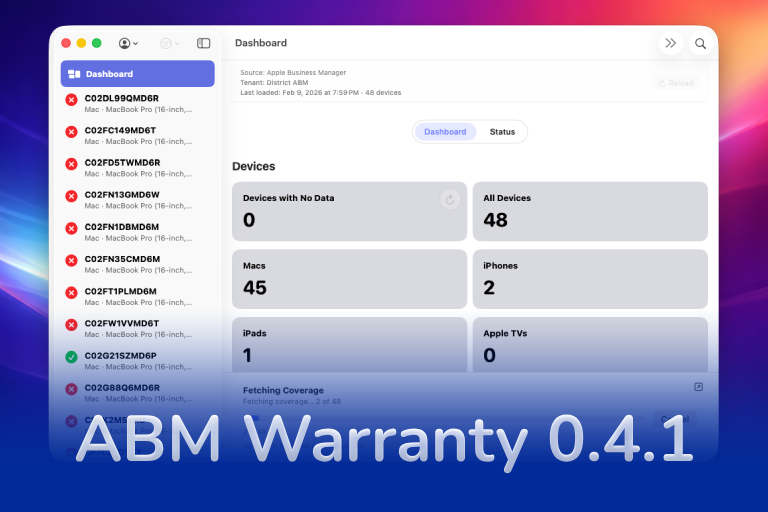
ABM Warranty 0.4.1
The 0.4.x release series for ABM Warranty is focused on operational scale. The earlier 0.3 releases were about trust, correctness, and stabilizing the foundation. Version 0.4.1 builds directly on that work by making the app more practical for consultants, internal IT teams, and managed service providers who need to support multiple environments without losing isolation, control, or visibility. This includes improvements to user interface and workflow, as well as enhanced reporting capabilities to help these users manage their workflows more efficiently.
The warranty dashboard Apple doesn’t provide… yet
Download ABM Warranty
Why Apple Fleet Risk Isn’t a Security Problem—Until It Is
Security and risk are often treated as interchangeable concepts in modern IT environments, but they are not the same discipline. Security focuses on controls, enforcement, and prevention. Risk management, by contrast, is concerned with likelihood, impact, and consequence across operational, financial, and organizational domains. Frameworks such as those published by NIST make this distinction explicit: risk assessment is not a technical exercise, but a business one. Technology informs risk decisions, but it does not define them.