
In this final ABM Warranty 0.4.1 walkthrough, I’m wrapping up the last features I had not covered directly in the earlier videos and then focusing on support, community, and the beta program. I also want to show where the support resources live inside the app so you know where to go if you need help, documentation, or a way to send useful feedback.
Before anything else, I want to call out the people who have participated in the beta program. The feedback, logs, screenshots, and bug reports have all helped improve the app. That input is a big reason the release is in a better place now than it would be otherwise.
One More Thing…
One of the remaining 0.4.1 features I had not covered directly in the earlier walkthroughs is the ability to reload a single device or reload only the device set represented by a filtered view instead of forcing a full synchronization every time.
That matters because a full sync can be expensive in larger environments. If you are dealing with a very large fleet and a small set of devices failed to sync cleanly, waiting for another full synchronization is slow and unnecessary. I built this so you can target the affected records instead of starting over from the top.
There are really two practical cases here. The first is a device record that truly has no data in Apple Business Manager. In that case, the app can try to fetch it again, but there is still nothing there to retrieve because the record itself is incomplete upstream. The second case is a device that ended up in a bad state because a sync stalled, throttling happened, or another outside issue interrupted the import. That second case is exactly where the targeted reload becomes useful.
If I am looking at a filtered set of devices that have no data, I can use the reload action on that filtered state and the app will attempt to refetch just those affected records. That is a much better operational workflow than forcing a full dataset reload for a relatively small subset of problem devices.
Where to Find Help Inside the App
I also wanted to use this final video to point out the help and support resources built directly into the app. Under the Help menu, there are several ways to get to documentation and support information.
The help book covers the app from the first release through the current version, so you can use it as a reference no matter which feature you are trying to understand. I wanted that help layer in the app itself because I do not want support to depend entirely on finding the right external link every time.
The Help menu also includes quick links out to the GitHub resources and the wiki. Those links are especially useful if you are working with advanced features like managed preferences, multiple credentials, or multi-tenancy, because those workflows depend on the utilities repo and the supporting wiki documentation.
Resources and sources
Those three resources all point you into the same support ecosystem, but they serve slightly different purposes depending on whether you need the script itself, the broader wiki, or the packager-specific documentation.
The Support GPT and the Slack Community
Another support path built into the app is the dedicated ABM Warranty Support GPT. I seeded it with information from the different versions of the app so it can answer support questions based on the current feature set and the earlier release behavior.
That gives you another option when you need a quick answer about how the app works.
I also want people using ABM Warranty to join the Mac Admins Slack, especially the #abmwarranty channel. That channel gives you a direct place to discuss the app, share feedback, ask questions, and stay connected to the community around the project.
The Mac Admins Slack is already one of the most useful resources in the broader Apple admin community. Having a dedicated ABM Warranty channel inside that space makes support and discussion much easier to keep active.
How to Join the Public Beta
The beta program is there for people who want access to builds that are still in active development. That means you may get fixes sooner, you may get new features earlier, and you may also run into bugs that have not been fully ironed out yet.
That is the tradeoff. If you join the beta, you are getting access to work in progress, not just polished release builds. But for users who want to help shape the app and get earlier access to fixes, that is where the beta is valuable.
The beta uses TestFlight. To join the public beta directly, use the ABM Warranty TestFlight link. The workflow is the standard Apple beta path:
- Open the ABM Warranty TestFlight link.
- Install TestFlight if you do not already have it.
- Open the beta in TestFlight.
- Accept the Apple terms.
- Install the ABM Warranty beta build.
Once you are in, you can keep automatic beta updates enabled, stop testing whenever you want, and continue receiving new beta builds as they are published.
How I Want Bug Reports and Logs
If you are participating in the beta and you hit an issue, the most useful thing you can send me is the logs tied to the issue, especially when debug logging is enabled and the problem can be reproduced.
That is why I included the log window in the app. From the Window menu, you can open the ABM logs, review the recent log output, reveal the logs in Finder, and export the session logs when needed.
If I ask for debug information specifically, the process is straightforward:
- Open the log window.
- Turn on debug logging.
- Reproduce the issue.
- Export the logs.
- Send those logs in for review.
That is the kind of support workflow that actually helps fix real bugs. It gives me the context I need instead of forcing guesswork.
Wrapping Up 0.4.1
ABM Warranty 0.4.1 adds much more than one feature. Across the whole series, I covered the dashboard, multiple credentials, managed preferences, and the operational guardrails that make the app more useful in real environments. This final walkthrough is where I wanted to close the loop by covering the remaining reload behavior and pointing people directly to the support and beta resources.
If you are using the app now, the help resources, Slack channel, and beta program are all there if you want deeper support, faster feedback loops, or earlier access to what I am working on next.

Support Indie Development
These apps are built in my free time.
I build and maintain these tools as an indie developer outside of client work and day-to-day responsibilities. If you find these apps useful and want to help fund continued development, updates, support, and new releases, you can sponsor the work directly.
Monthly support helps me keep shipping improvements, maintain compatibility, and invest more time into building practical software for the Apple admin and consultant community.
AI Usage Transparency Report
AI Era · Written during widespread use of AI tools
AI Signal Composition
Score: 0.3 · Moderate AI Influence
Summary
In this final ABM Warranty 0.4.1 walkthrough, I’m wrapping up the last features I had not covered directly in the earlier videos and then focusing on support, community, and the beta program. I also want to show where the support resources live inside the app so you know where to go if you need help, documentation, or a way to send useful feedback. Additionally, I'll be covering some of the key features that were updated since the previous version, including any bug fixes or improvements made to existing functionality.
Related Posts

Automating JAMF Pro Email Notifications with SendGrid (Smart Group Driven Workflows)
Modern device management isn't just about enforcing policies—it's about communicating effectively with users at the right time. In JAMF Pro, Smart Groups give you powerful visibility into device state, but they don't natively solve the problem of proactive, automated user communication. Whether you're trying to prompt users to restart their machines, complete updates, or take action on compliance issues, bridging that gap requires a flexible and scalable notification system.
Introducing Pique - The Game-Changing Quick Look Plugin for Mac Admins
As a Mac admin, I'm always on the lookout for tools that make my life easier and more efficient. Recently, I stumbled upon Pique - a brilliant Quick Look plugin created by Henry Stamerjohann that allows you to view file contents in a syntax highlighted way.
ABM Warranty 0.4.1 Walkthrough: Managed Preferences
In this part of the ABM Warranty 0.4.1 walkthrough series, I'm focusing on managed preferences and the credential packaging workflow. In the last video, I covered multiple credentials inside the app itself. In this one, I'm showing how to package those credentials so they can be deployed securely through MDM. This process is a crucial step in ensuring that your credentials are properly configured and protected within your organization's mobile device management system.
Low Profile Walkthrough and Review
Today I’m walking through Low Profile, a utility from Nindi Gill that I use when I want to inspect profiles already installed on a Mac and figure out whether those profiles contain issues I need to clean up. The value is that Low Profile gives me a straightforward way to inspect profiles installed on any Mac. This simplicity makes it easy for me to identify and address potential problems, which is especially useful when working with multiple machines or troubleshooting complex profile configurations.
ABM Warranty 0.4.1 Walkthrough: Multiple Credentials
In this part of the ABM Warranty 0.4.1 walkthrough series, I’m focusing on multiple credentials. In the first video, I showed the basic setup and how to add a single credential. Now, I want to explore what happens when I remove a credential, what changes occur when I add more than one, and how the app behaves once there are multiple contexts in play. This will help clarify any potential issues or inconsistencies that may arise with multiple credentials.
QuickPKG Walkthrough and Review
I use QuickPKG when I need to turn an application, DMG, or ZIP file into a package quickly without wasting time in a heavier packaging workflow. This post follows the same path as my video: what QuickPKG is, where to get it, how I run it, what a simple packaging example looks like, and where I think admins need to be careful about potential pitfalls that can arise from using this tool.
ABM Warranty 0.4.1 Walkthrough: Introduction
In this first ABM Warranty 0.4.1 walkthrough, I want to show you what the app actually does before I get into the more specific feature videos. This is the broad introduction. I’m walking through the dashboard, how I think about the warranty cards, how released devices are handled, how the filters work, how to add credentials, where the data is stored locally, and what the logging and security model looks like.
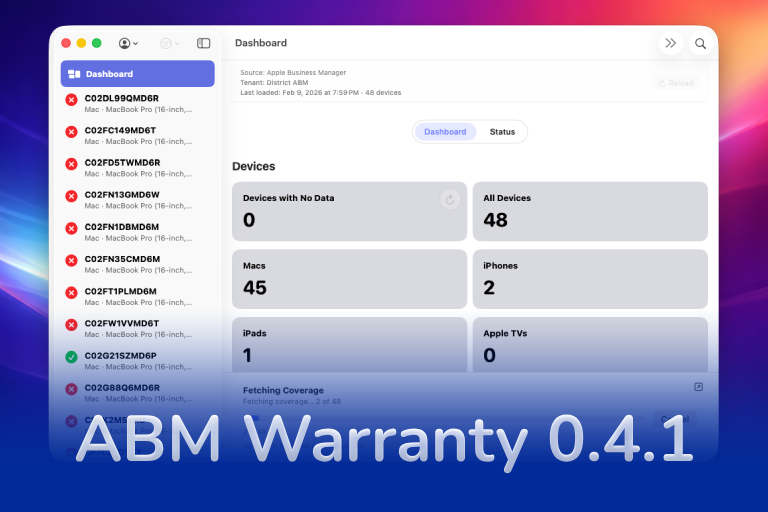
ABM Warranty 0.4.1
The 0.4.x release series for ABM Warranty is focused on operational scale. The earlier 0.3 releases were about trust, correctness, and stabilizing the foundation. Version 0.4.1 builds directly on that work by making the app more practical for consultants, internal IT teams, and managed service providers who need to support multiple environments without losing isolation, control, or visibility. This includes improvements to user interface and workflow, as well as enhanced reporting capabilities to help these users manage their workflows more efficiently.
The warranty dashboard Apple doesn’t provide… yet
Download ABM Warranty
Why Apple Fleet Risk Isn’t a Security Problem—Until It Is
Security and risk are often treated as interchangeable concepts in modern IT environments, but they are not the same discipline. Security focuses on controls, enforcement, and prevention. Risk management, by contrast, is concerned with likelihood, impact, and consequence across operational, financial, and organizational domains. Frameworks such as those published by NIST make this distinction explicit: risk assessment is not a technical exercise, but a business one. Technology informs risk decisions, but it does not define them.