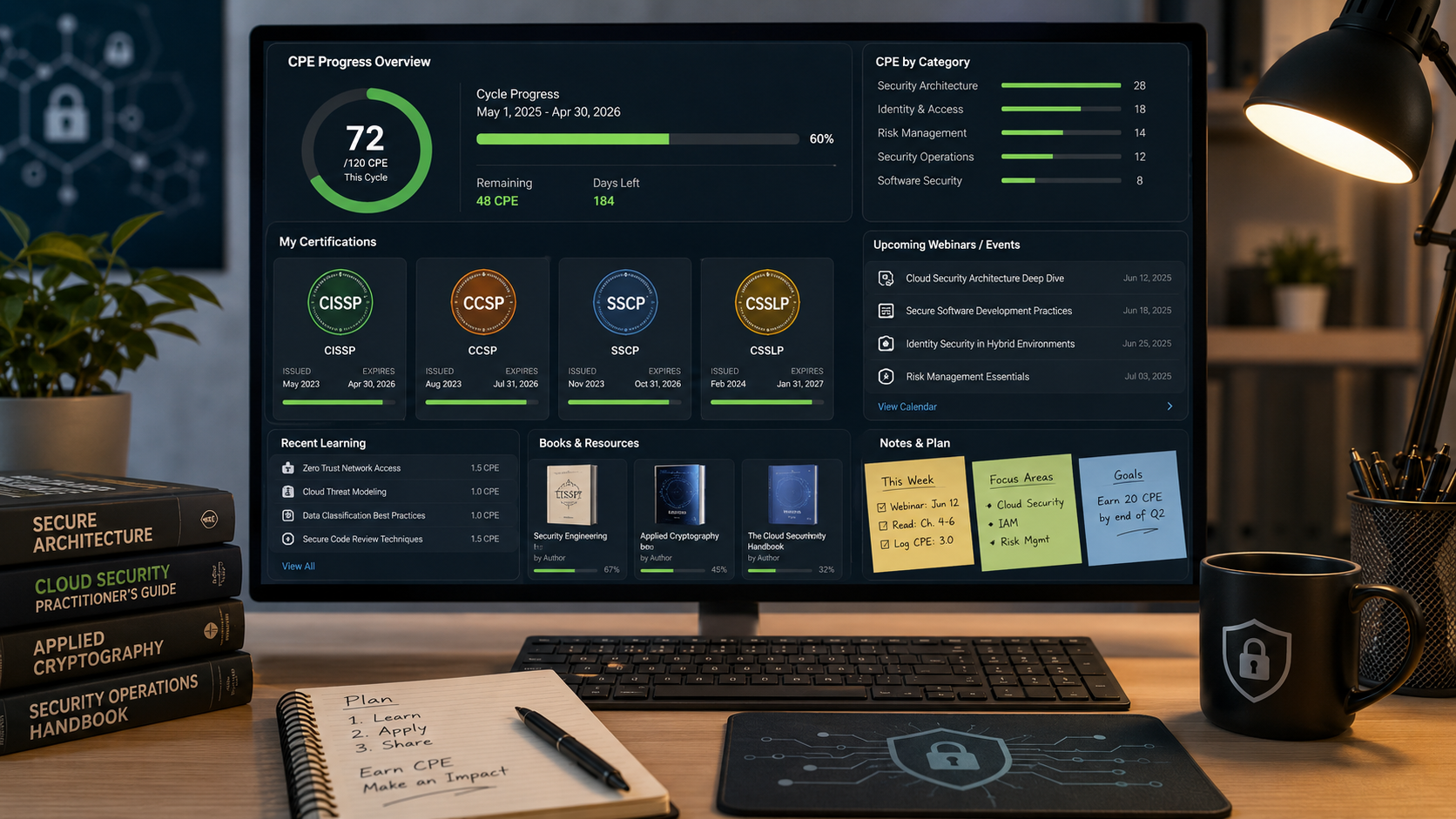

I have had the same conversation a bunch of times now.
Someone gets their CISSP, CCSP, SSCP, CSSLP, or another ISC2 certification, the celebration wears off, and then the renewal dashboard starts looking like homework. The question is usually some version of: “How am I supposed to get all these CPE credits?”
The honest answer is that it is not hard. It only feels hard if you wait until the end of the cycle and try to manufacture a pile of credits from scratch.
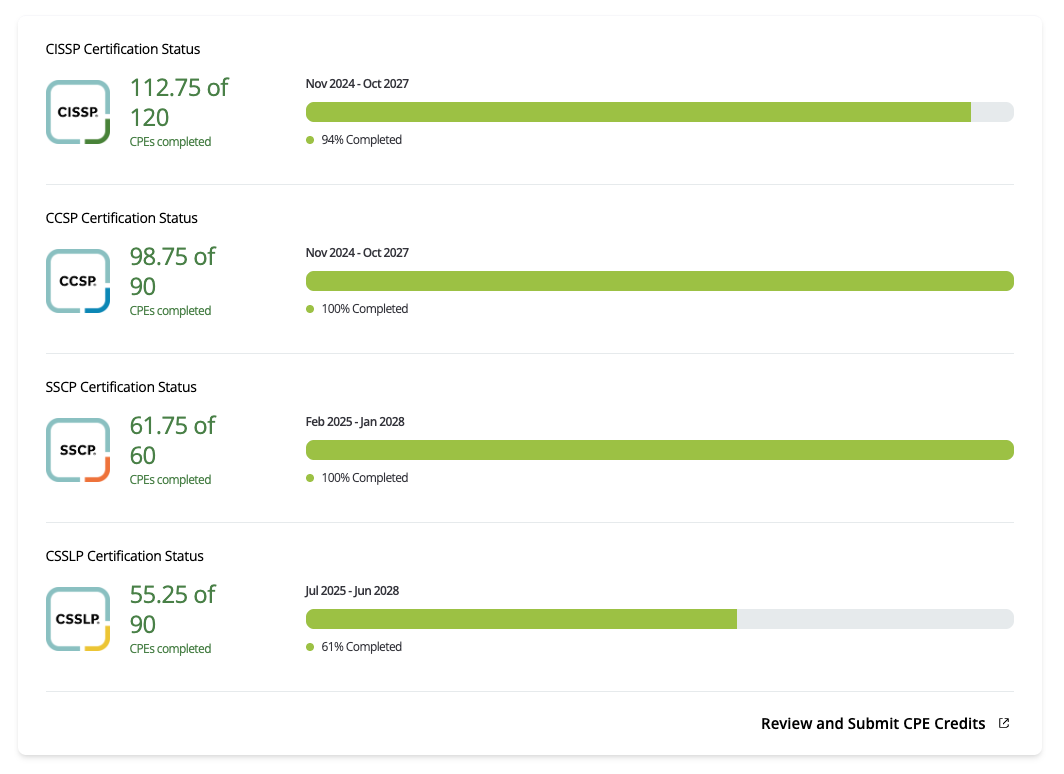
My current dashboard is a good example. For the cycle shown below, my CISSP is at 112.75 of 120 CPEs, CCSP is at 98.75 of 90, SSCP is at 61.75 of 60, and CSSLP is already at 55.25 of 90. That did not happen because I disappeared into some three-month study bunker. It happened because I started treating CPEs as a side effect of normal professional work: reading, attending webinars, preparing talks, doing real security projects, and saving evidence as I go.
The trick is to stop thinking about CPEs as a separate chore. If you work in security, IT, compliance, software, cloud, or risk, you are probably already doing things that count. You just need to recognize them, track them, and submit them while the details are still fresh.
First, Know What ISC2 Is Actually Asking For
ISC2 separates continuing education into Group A and Group B credits. Group A is the important one for most of us because it maps to cybersecurity and the domains of the certification. Webinars on cloud security, secure software, incident response, risk management, AI security, identity, CMMC, vulnerability management, and security operations can all fit here when they line up with the certification domains.
Group B is broader professional development. Leadership training, communication, project management, burnout and resilience, and other non-cybersecurity professional development can help, but only up to the limits ISC2 sets for the certification. ISC2’s own CPE guide also calls out the basic math: one CPE per hour, partial credits in 0.25 increments, and the end date of the activity determines the cycle it applies to.
That last part matters. If you attend something in October, submit it as an October activity. Do not wait six months and try to reconstruct the title, speaker, duration, and domain mapping from memory.
My Pattern Is Boring, Which Is Why It Works
Looking through my CISSP transcript, the credits were not evenly distributed. They looked more like a poll result, which is useful because it shows where I naturally picked up credits and where I was lighter.
That breakdown is more honest than a generic list. I am heaviest on structured training, certification prep, books, webinars, and public-sector sessions. I am lighter on presentation prep and Group B professional development. Vendor sessions helped, but they were not the whole strategy. The CMMC work mattered too, but I treat unique work experience as a special category, not something to pad every month.
That mix is the whole point. I do not rely on one source. If I read a serious security book, I log it. If I attend a relevant webinar, I log it. If I prepare a security presentation, I log the preparation. If I do a project that is outside my normal day-to-day responsibilities and maps to the domains, I look at whether it qualifies as unique work experience.
The best part is that some ISC2 activities auto-submit. ISC2 says its webinars can earn CPE credits, and its Knowledge Vault page says members can earn 1 CPE per 45-minute webinar. That makes ISC2 webinars one of the lowest-friction sources because the credit usually lands in your account later. I still keep my own note anyway, because auto-submission can take time and I do not like trusting one system to be my only memory.
The Easy Button: ISC2 Webinars And Shared Credits
If someone wants the lowest-friction starting point, I usually tell them to start with ISC2’s own webinars.
ISC2 runs webinars all the time. Security Briefings, Knowledge Vault, Spotlight events, Think Tank sessions, and vendor showcases all show up throughout the year. The useful part is not only that they are relevant. The useful part is that ISC2 captures the evidence and can automatically submit the CPE activity for you when you register and attend with the right account information.
That removes two of the most annoying parts of the process: saving proof and remembering to file. I still keep my own tracker, but ISC2 webinars are the closest thing to an easy button because the evidence chain is already inside the same ecosystem as the certification.
The other thing people miss is that one CPE activity can help more than one ISC2 certification when it maps to the domains. If a webinar on cloud IAM is relevant to both CISSP and CCSP, or a secure software book maps to CISSP and CSSLP, do not submit it as if it only belongs to one credential. Pick the relevant domains for every certification it honestly applies to.
If you are unsure which domains fit a webinar, book, or training session, this is a good place to use AI as a drafting assistant. Do not let it invent credits, and do not treat it as the authority. Use it to organize the mapping, then check the result against ISC2’s rules before submitting.
CISA Is One Of My Favorite Free Sources
The big one I always tell people about is CISA.
CISA and NICCS publish a lot of cybersecurity training, events, and awareness material. Not every CISA page is going to magically auto-submit to ISC2, so I treat these as manual CPE candidates: attend the webinar, save the registration or completion email, note the title and duration, and map it to the certification domains when I submit it.
That is the distinction that keeps you out of trouble. Free public training can be excellent, but you still need evidence. I usually keep:
- The event title
- The event date
- The duration
- The registration or completion email
- A screenshot or agenda if available
- A one-line note explaining why it maps to a certification domain
For people in government contracting, CMMC, incident response, vulnerability management, critical infrastructure, or security awareness, CISA material is especially useful because it is usually grounded in the exact things we deal with at work.
Start here:
Webinars Are The Easy Mode, But Pick The Right Ones
Webinars are the easiest way to build a steady CPE rhythm. They are also where people get lazy.
Do not just join anything with “cyber” in the title and call it good. Pick sessions that match what you actually do or what you are trying to get better at. My transcript has cloud security, AI application security, IAM, behavioral email security, ransomware, living-off-the-land techniques, vulnerability management, and CMMC. Those are not random topics. They map to work I care about and certifications I hold.
My usual sources:
Vendor webinars can count too, and my transcript has plenty of them. The filter I use is simple: did I learn something security-relevant, was it more than a product pitch, and can I explain the domain mapping if audited? If the answer is yes, I save the evidence and submit it. If the answer is no, I do not try to force it.
Books Still Count, And They Are Underrated
Books are one of the most overlooked CPE sources. ISC2’s CPE guide explicitly includes reading books, magazines, and white papers as self-directed learning when the topic maps to the certification domains.
I used this heavily while working through SSCP and CSSLP material. My transcript includes the Official ISC2 Guide to the CSSLP CBK, Essential CSSLP Exam Guide, All In One CSSLP, the SSCP Official Study Guide, and SSCP Official Practice Tests. Those were not just exam prep resources. They also counted as professional learning because they were tied directly to security domains.
For 2026, I would think about books in three buckets.
First, certification-aligned books. If you recently passed CISSP but are moving into CCSP, CSSLP, or SSCP, keep reading domain-specific material. It sharpens your work and gives you clean Group A evidence.
Second, practitioner books. For security engineering and software security, I still like Building Secure & Reliable Systems because it connects security with reliability and production operations. For developers moving into security, Web Security for Developers is approachable and concrete. For application security, Alice and Bob Learn Application Security is still a good recommendation if you want something practical instead of theory-heavy.
Third, strategy and architecture books. If you are trying to think more like a security leader, Cybersecurity First Principles is worth looking at because it organizes security around enduring ideas instead of tool churn.
The evidence habit is the same: title, author, date completed, rough time spent, and a short note about the domains. Do not submit “read a book” with no context.
Presenting And Teaching Counts More Than People Realize
One thing I like about the CPE model is that it recognizes contribution, not just consumption.
My transcript includes preparation credits for “Introduction to Log Management” and “Create your own AI Agent.” Those are good examples because preparing to teach or present forces you to organize the topic, check your assumptions, and explain it clearly. That can be more valuable than passively watching another webinar.
If you run an internal lunch-and-learn, prepare security awareness material, present to a client, build training for your team, write a technical article, contribute to a security group, or help with exam or content development, check the ISC2 rules before ignoring that work. You may already be doing CPE-worthy activity.
The catch is evidence. Keep the slide deck, agenda, meeting invite, outline, article link, or prep notes. If you ever get audited, you want to show what you did without scrambling.
Unique Work Experience Is Real, But Do Not Abuse It
My transcript also includes unique work experience for a CMMC Level 2 project. That is a real category, but I would be careful with it.
ISC2 describes unique work experience as work performed during working hours when it relates to a unique project or assignment outside your day-to-day responsibilities. That phrase matters. Your normal job is not automatically a CPE farm. But a special project, migration, assessment, implementation, audit, or security initiative may qualify when it is meaningfully outside the ordinary routine and maps to the domains.
For this category, I would keep better notes than usual:
- What the project was
- Why it was outside normal duties
- Which domains it mapped to
- Start and end dates
- Approximate hours
- Non-sensitive evidence, such as a sanitized project plan or completion note
Do not upload client confidential material or anything sensitive just to prove a CPE. Save enough to show the nature of the work without creating a data handling problem.
My Simple System
The system I recommend is almost embarrassingly simple.
Keep one running note or spreadsheet with these columns:
Date | Title | Source | Type | Hours | Group A/B | Cert domains | Evidence saved? | Submitted?
When you register for a webinar, add it. When you finish a book, add it. When you prepare a presentation, add it. When the CPE is submitted, mark it. When ISC2 auto-submits something, still reconcile it against your list.
I also try to submit credits while the activity is fresh. ISC2’s CPE guide recommends keeping a log and not delaying submissions, and that matches my experience. The longer you wait, the more annoying the process gets.
The other habit that helps if you hold multiple ISC2 certifications is selecting all relevant domains during submission. ISC2 notes that CPE activities can count toward multiple certifications when the activity maps to the relevant domains. That is how one strong webinar on cloud IAM or secure software can help across CISSP, CCSP, and CSSLP when the mapping is legitimate.
The Part Nobody Wants To Hear
You still have to do the work.
There is no shortcut where you click through a bunch of random videos at the end of the cycle and somehow become a better security professional. But there is a much easier way than panic-submitting credits near the deadline. Make learning part of the week. Pick topics that connect to your actual work. Save evidence as you go. Submit while the details are fresh.
That is how I got my dashboard into a comfortable place without making CPEs a second job.
If you just passed your exam, enjoy that win. Then set up the tracker now, register for a couple of ISC2 or CISA sessions, pick one book you actually want to read, and start banking credits before the renewal clock turns into stress.
Sources
- ISC2 CPE Opportunities
- ISC2 Quick Guide to CPE Credits
- ISC2 Webinars
- ISC2 Security Briefings
- ISC2 Knowledge Vault
- CISA Events
- CISA Training
- NICCS Education & Training Catalog
- Federal Virtual Training Environment
- SANS Webcasts
- Building Secure & Reliable Systems
- Web Security for Developers
- Alice and Bob Learn Application Security
- Cybersecurity First Principles
AI Usage Transparency Report
AI Era · Written during widespread use of AI tools
AI Signal Composition
Score: 0.1 · Low AI Influence
Summary
Keeping up with ISC2 CPE credits is easier when you treat it like a normal professional habit instead of a renewal emergency. Here is the system I use across CISSP, CCSP, SSCP, and CSSLP, with free and low-friction sources for webinars, books, training, and work-based credits.
Related Posts
Bromure Gives Codex a Room of Its Own
I installed Bromure Agentic Coding, watched it build the Linux VM, authenticated Codex, and followed a real Codex task through the workspace.

Amnesia Stealer Shows the Next Stage of ClickFix on macOS
Amnesia Stealer shows how ClickFix-style social engineering is adapting on macOS, while a public malware sample gives defenders an opportunity to study the behavior behind the campaign.
Reporting on Microsoft 365 DLP Overrides with PowerShell
DLP overrides are not automatically bad. They are a business process that needs visibility. This walkthrough covers a Microsoft Purview DLP policy, a custom sensitive information type, user override behavior, and a PowerShell report that exports override events from Activity Explorer.
Move Entra Users Off SMS and Voice Before Microsoft Retires Them
Microsoft is retiring Microsoft-provided SMS and voice authentication in Entra ID. The migration is not passkeys for everyone; it is removing weak telecom MFA and choosing supported replacement methods such as Microsoft Authenticator, FIDO2 keys, certificate-based authentication, OATH hardware tokens, or customer-managed telecom.
macOS Tahoe 26.6.1 Fixes a High-Severity Screen Sharing Authentication Bypass
macOS Tahoe 26.6.1 fixes CVE-2026-65400, a high-severity Screen Sharing authentication issue where an attacker on the network may be able to authenticate without valid credentials.
ClickLock Shows Why Terminal Paste Is a Mac Security Boundary
ClickLock Stealer shows why Mac security teams should watch for Terminal paste lures, fake AppleScript password prompts, command-line Keychain access, LaunchAgent persistence, and Jamf Protect alerts that can route suspected Macs into Jamf Pro response groups.
CrashStealer Shows the Gap Between Notarization and Detection
CrashStealer shows the security gap between Apple's Developer ID notarization path and App Store review, and why Jamf's behavioral detection mattered.

The CMMC Pause Does Not Make a Level 2 Audit Worthless
The July 2026 CMMC Phase II pause changes the timing of third-party assessment requirements, but it does not erase DFARS, NIST SP 800-171, SPRS, or the value of a completed Level 2 audit.
How We Structured and Hashed CMMC Evidence for Auditor Review
How folder naming, control-level artifact names, spreadsheet hyperlinks, and evidence hashing made a CMMC evidence package easier for the auditor to validate.
Opening the Ollama Black Box: Understanding the Trust Boundary Behind Local AI
Installing Ollama is easy. Understanding the trust boundary behind a local AI service is what determines whether it belongs in an automation workflow.