
Welcome to my blog
Join me on my journey as I share my insights and experiences on all things Apple, Business and Entrepreneurship!
Join me on my journey as I share my insights and experiences on all things Apple, Business and Entrepreneurship!
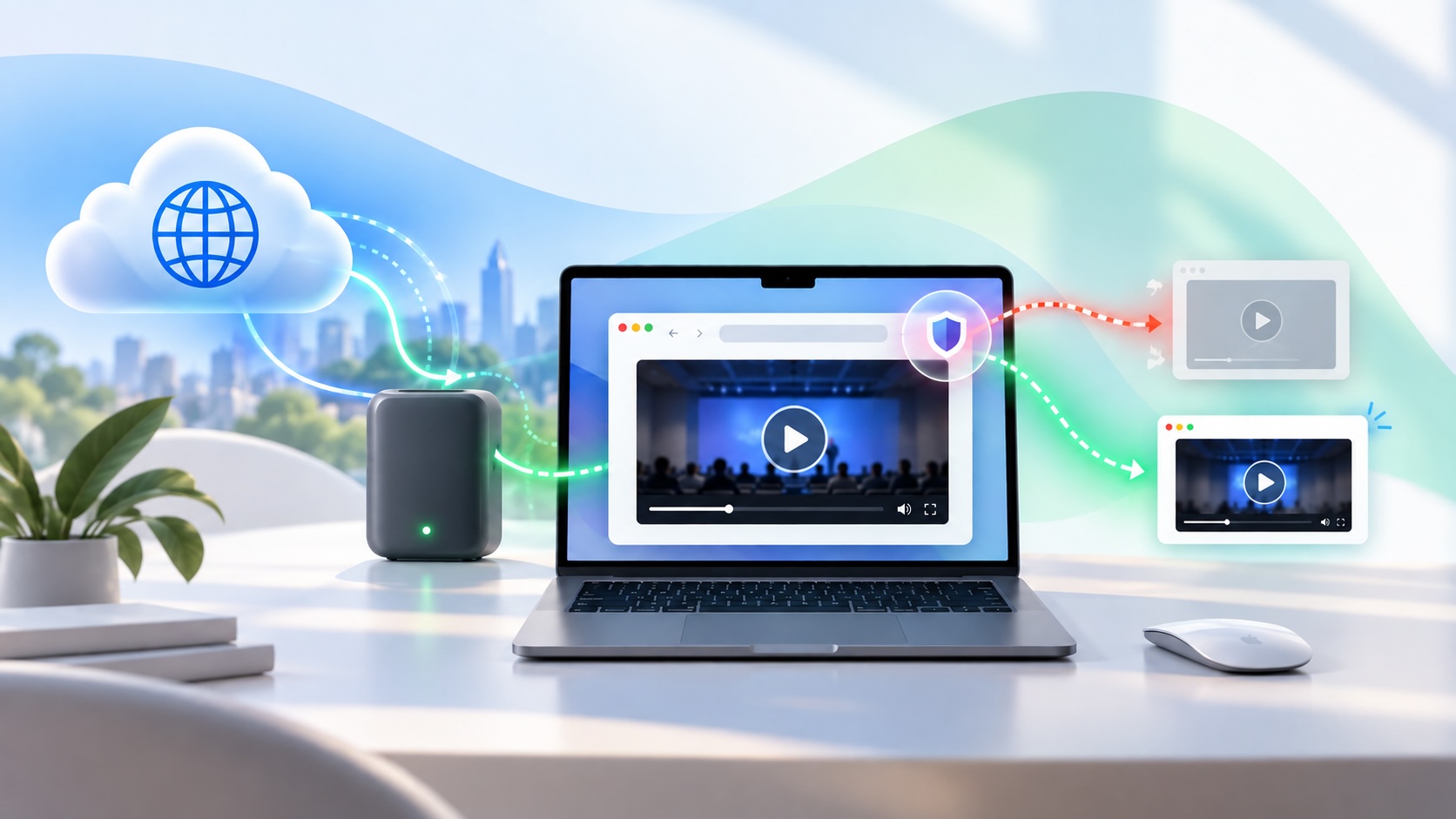
Turning off Jamf Trust fixed the webinar, which normally would have sent me straight to its routing policies. This time the route was fine: Chromium was treating Jamf's ZTNA broker addresses as a local network, and an Edge and Chrome preference corrected it.

Part one of a Clamshell iBook G3 restoration: a broken screen, a charger detour, a blinking system folder, a full teardown, and the backlight connector mistake that paused the project.

I installed Bromure Agentic Coding, watched it build the Linux VM, authenticated Codex, and followed a real Codex task through the workspace.

Claude Code Auto mode changes how approval decisions are handled. It does not expand the boundary of what the coding agent should be allowed to do.

Amnesia Stealer shows how ClickFix-style social engineering is adapting on macOS, while a public malware sample gives defenders an opportunity to study the behavior behind the campaign.
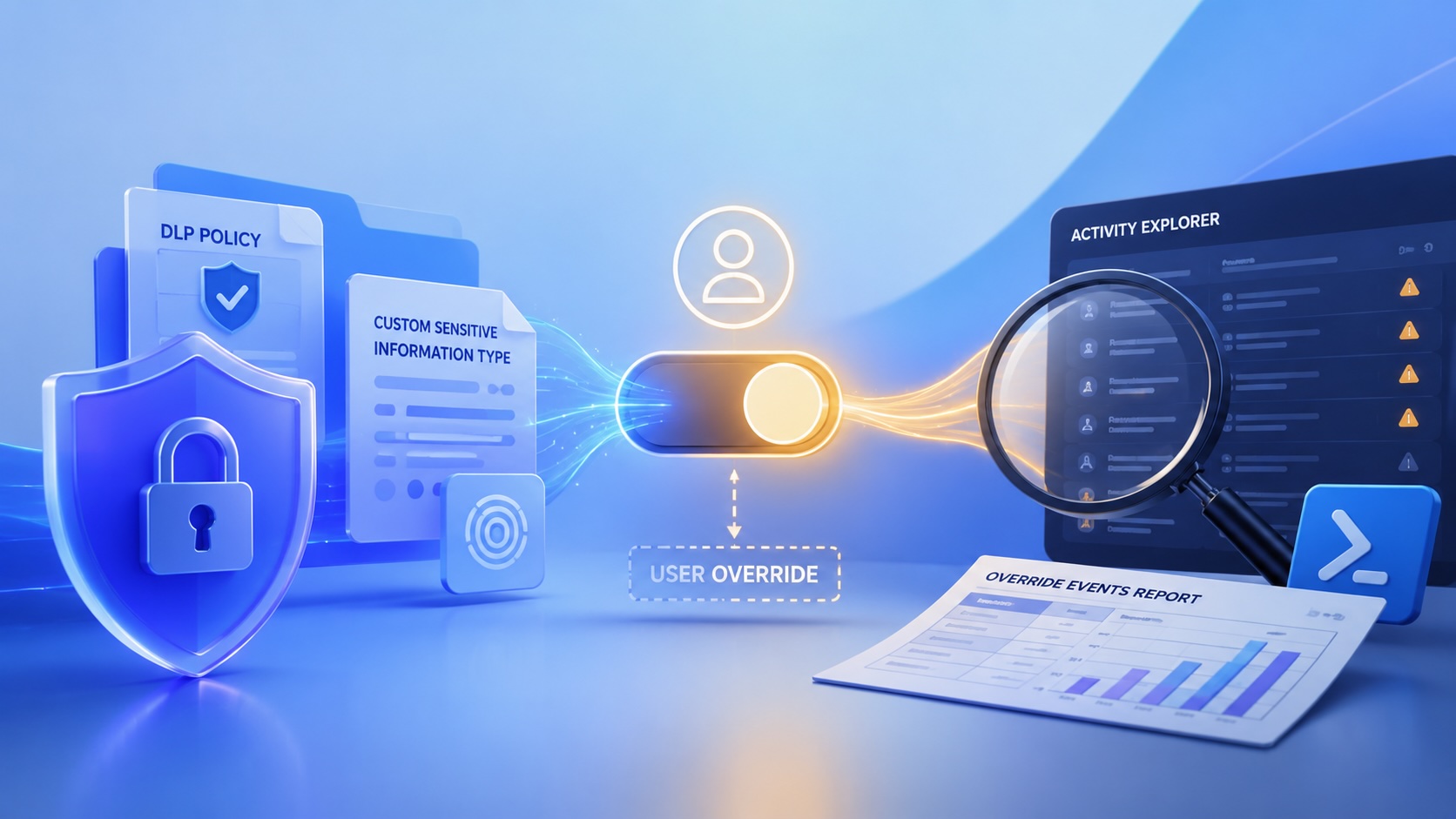
DLP overrides are not automatically bad. They are a business process that needs visibility. This walkthrough covers a Microsoft Purview DLP policy, a custom sensitive information type, user override behavior, and a PowerShell report that exports override events from Activity Explorer.
The PowerBook 140 project moved from preparing a BlueSCSI card in Basilisk II to installing the repaired internal SCSI cable, powering the BlueSCSI Pico externally from the battery bay, booting System 7.1, and fighting through DaynaPORT Wi-Fi setup.

Microsoft is retiring Microsoft-provided SMS and voice authentication in Entra ID. The migration is not passkeys for everyone; it is removing weak telecom MFA and choosing supported replacement methods such as Microsoft Authenticator, FIDO2 keys, certificate-based authentication, OATH hardware tokens, or customer-managed telecom.

A 22-inch Apple Cinema Display arrived with a broken acrylic easel stand, so I used a 3D printed replacement leg instead of sending the monitor back.

macOS Tahoe 26.6.1 fixes CVE-2026-65400, a high-severity Screen Sharing authentication issue where an attacker on the network may be able to authenticate without valid credentials.

Latest, Applite, and an all-in-one macOS update script each solve a different part of lightweight Mac maintenance: app update visibility, Homebrew-backed app management, and command-line package updates that can be wrapped carefully for small teams or basic MDM.

Natural is a small macOS menu bar utility that makes the natural scrolling toggle easy to reach, but building it from source also shows why open-source desktop utilities need clear prerequisite checks before they become recommended tools.

ClaudeChat-Snow-Leopard is interesting because it brings a modern Claude API workflow back to Mac OS X 10.6.8 with Objective-C, Cocoa, Keychain storage, screenshot uploads, and a native installer built for an older white MacBook.

LibrePods is interesting because it turns AirPods into an interoperability question: what happens when open-source software implements Apple's private AirPods protocol so Android and Linux users can reach features normally reserved for Apple's ecosystem?

Mac Performance Monitor belongs in the Mac admin toolbox because it records local performance history, helps Help Desk review slow-Mac reports after the moment has passed, and keeps process telemetry on the Mac instead of sending it to a cloud service.

Apple says macOS 28 will not support encrypted Mac OS Extended volumes, so older encrypted HFS+ external drives need to be identified, backed up, decrypted, converted, or reformatted before that upgrade.

ClickLock Stealer shows why Mac security teams should watch for Terminal paste lures, fake AppleScript password prompts, command-line Keychain access, LaunchAgent persistence, and Jamf Protect alerts that can route suspected Macs into Jamf Pro response groups.
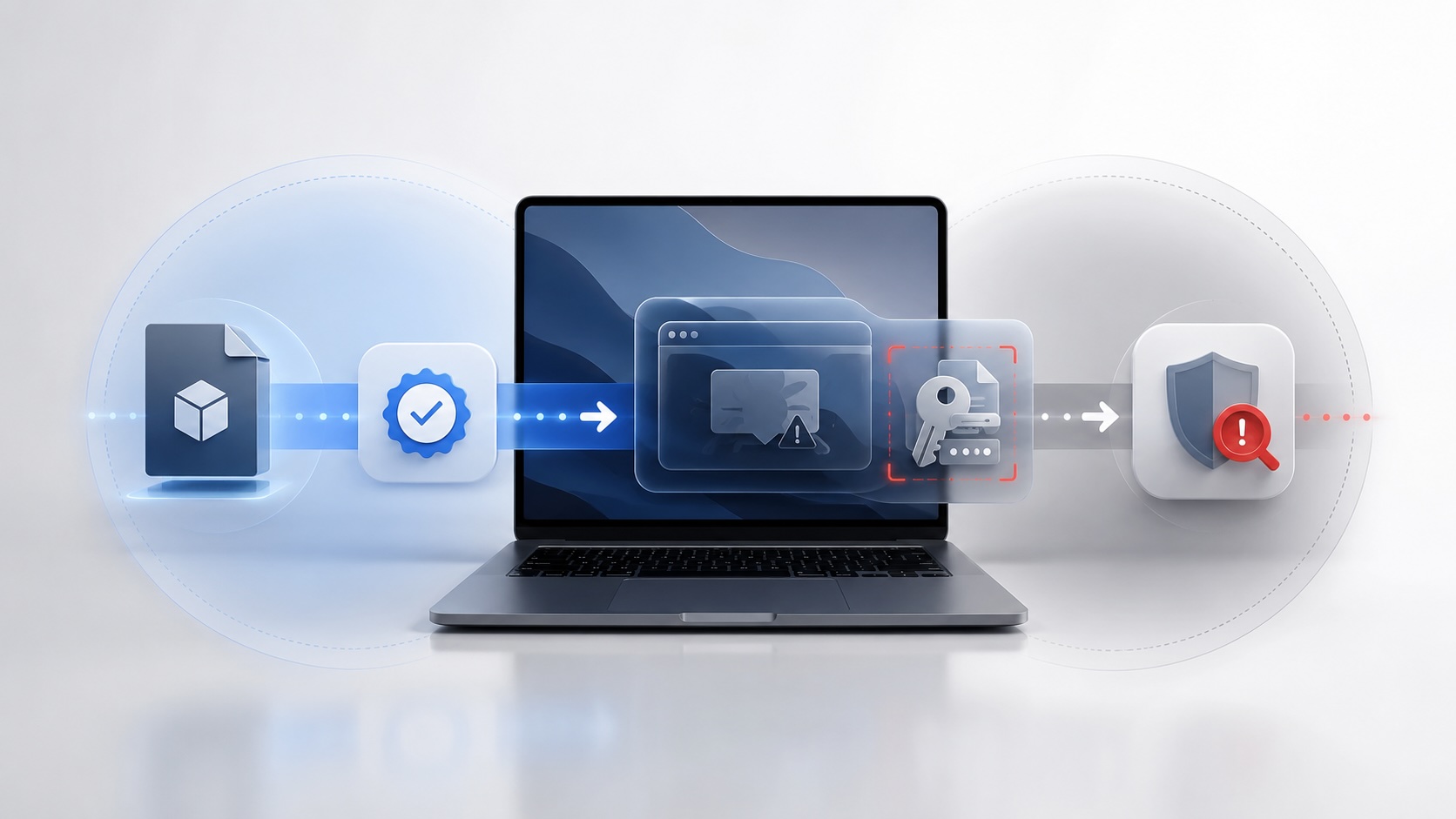
CrashStealer shows the security gap between Apple's Developer ID notarization path and App Store review, and why Jamf's behavioral detection mattered.
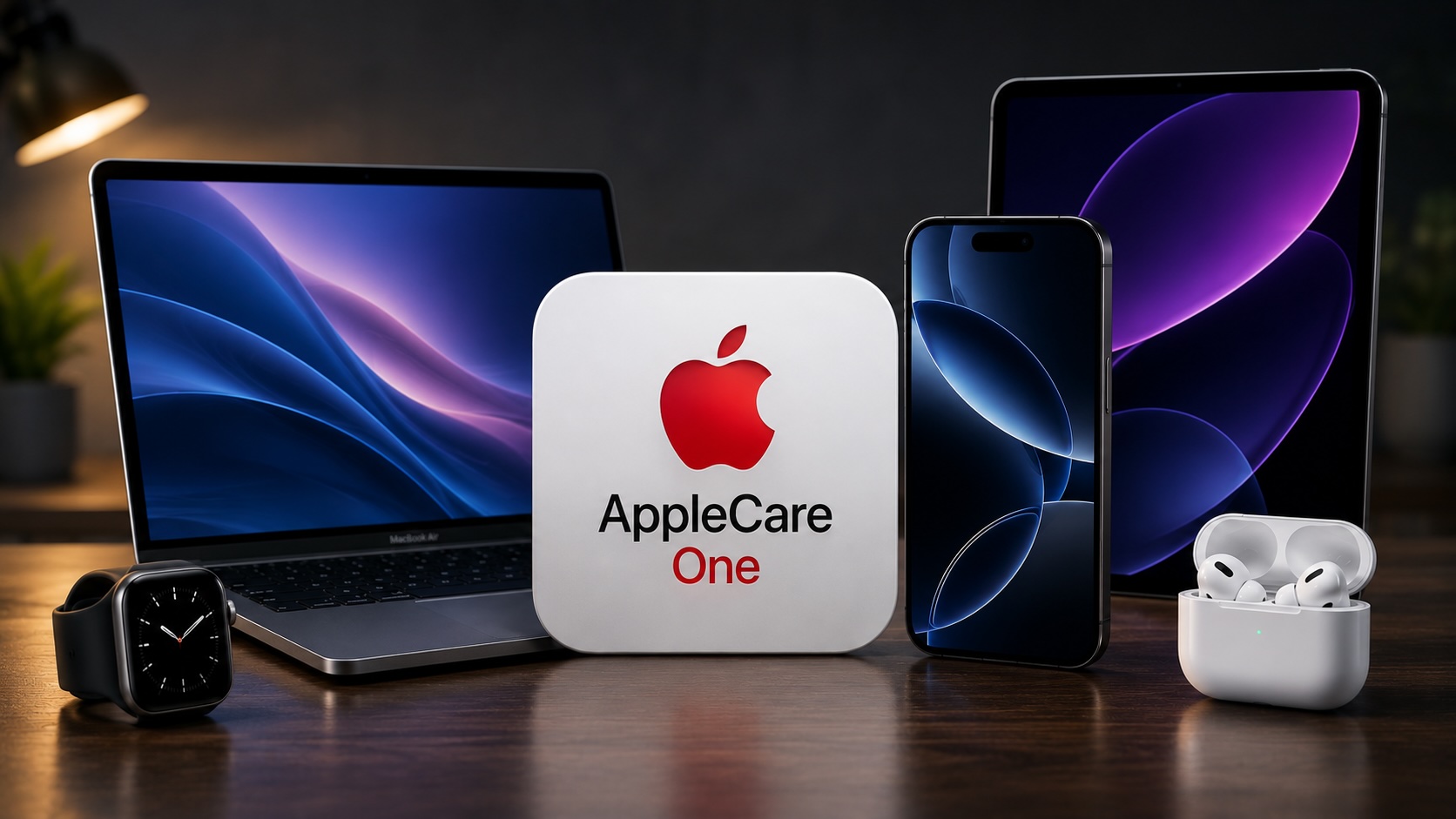
AppleCare One looks more valuable after AppleCare+ price increases for Macs and iPads, especially for people with several Apple devices and older eligible hardware.
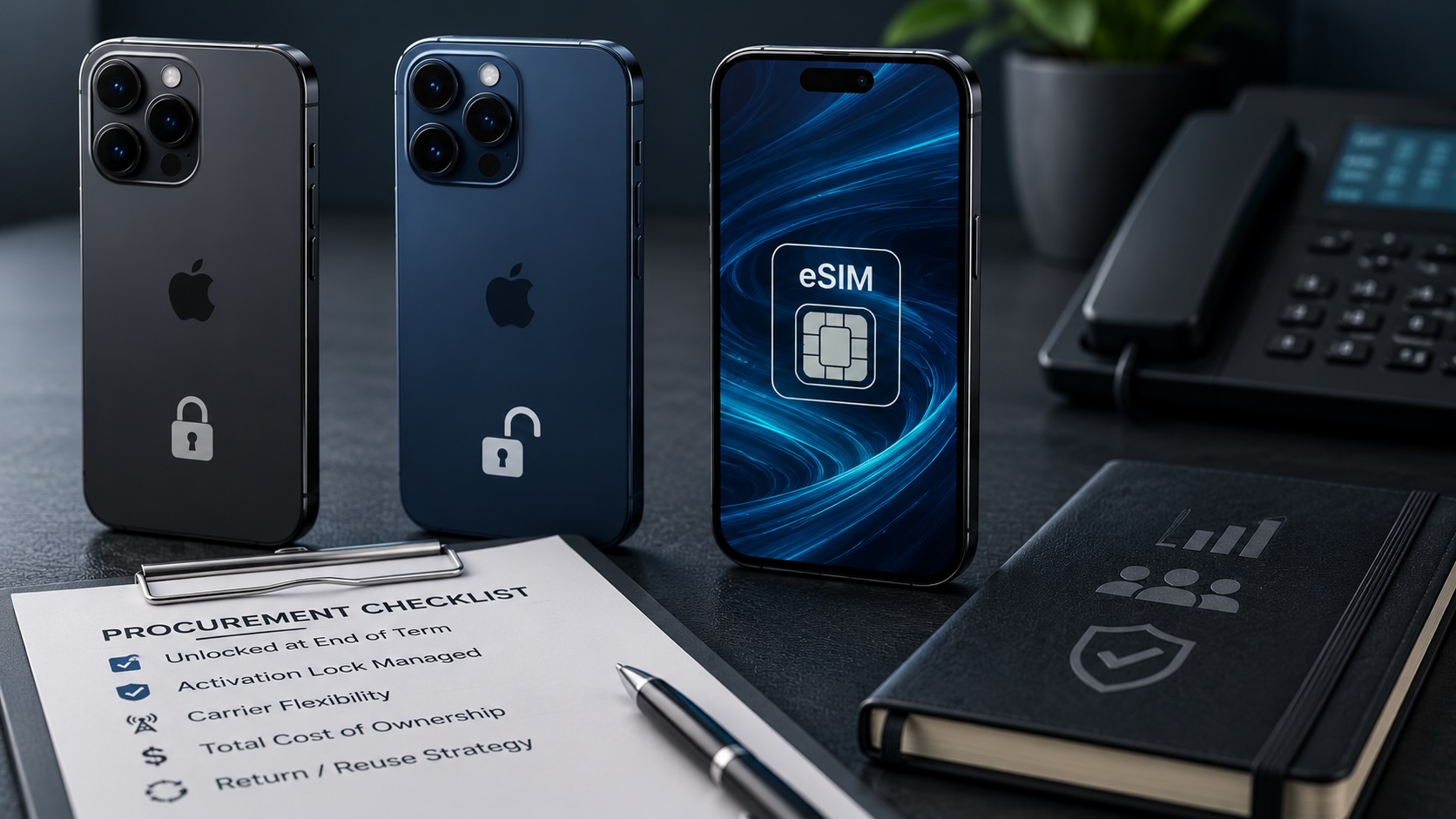
Apple's U.S. carrier financing change makes locked versus unlocked iPhones an operational buying decision for small businesses, BYOD users, and Apple fleet planners.

The July 2026 CMMC Phase II pause changes the timing of third-party assessment requirements, but it does not erase DFARS, NIST SP 800-171, SPRS, or the value of a completed Level 2 audit.
How folder naming, control-level artifact names, spreadsheet hyperlinks, and evidence hashing made a CMMC evidence package easier for the auditor to validate.
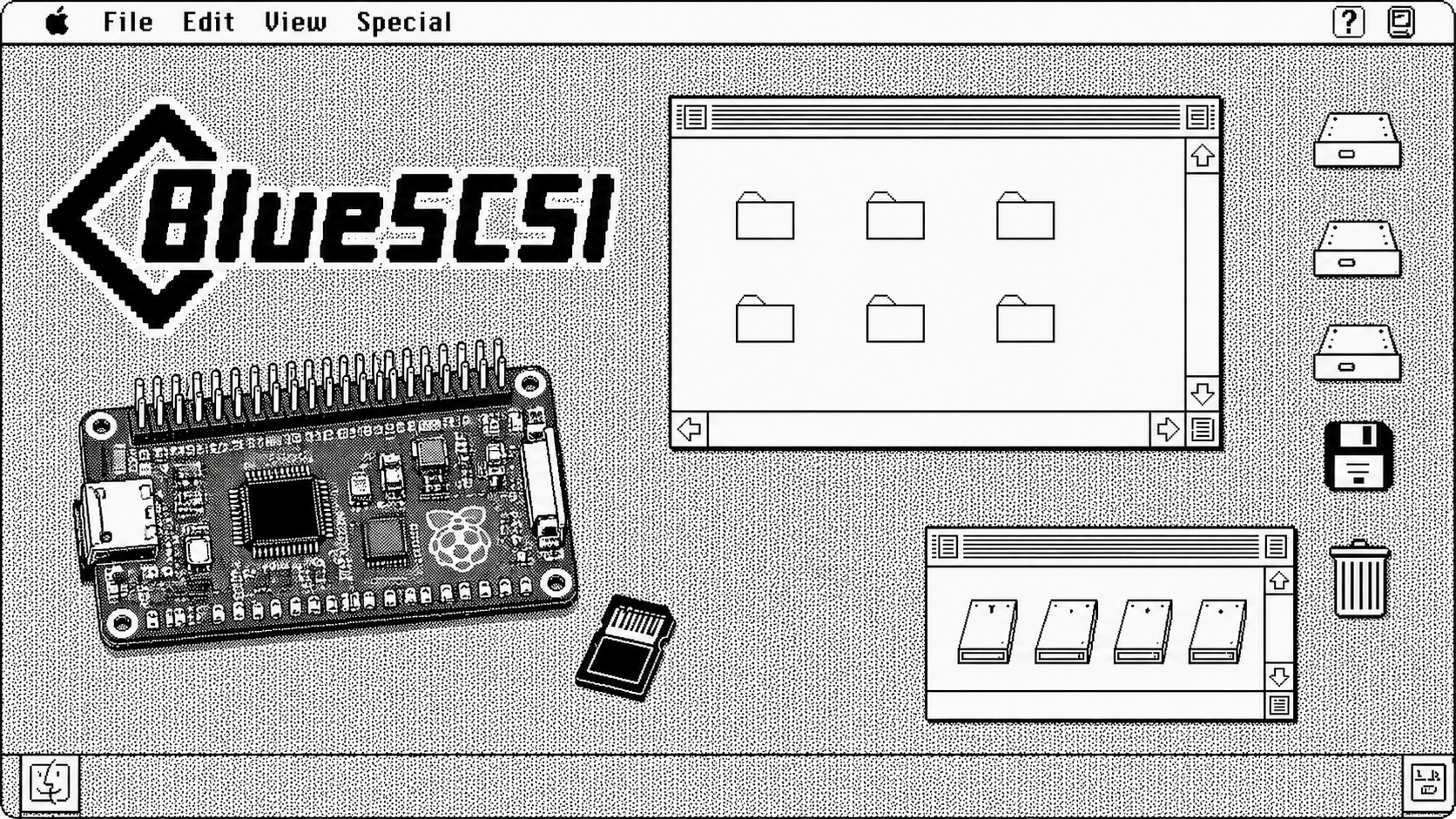
A step-by-step walkthrough for preparing a BlueSCSI v2 PowerBook card image with Basilisk II: download the pieces, configure the emulator, boot a working classic Mac image, mount the target System 7.1 image, stage tools, and shut down cleanly before moving the image to the card.

Keeping up with ISC2 CPE credits is easier when you treat it like a normal professional habit instead of a renewal emergency. Here is the system I use across CISSP, CCSP, SSCP, and CSSLP, with free and low-friction sources for webinars, books, training, and work-based credits.
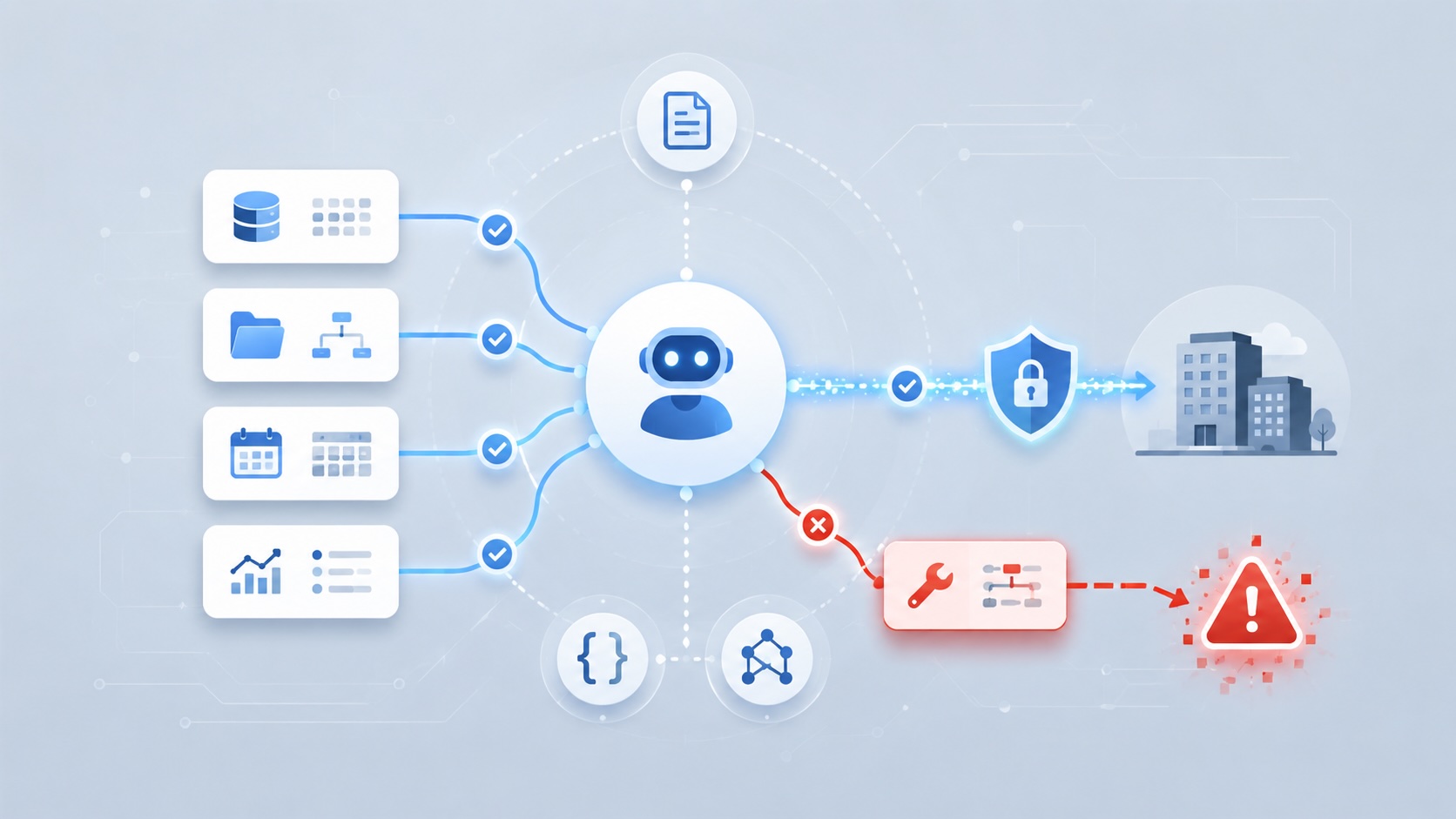
Microsoft's MCP tool-poisoning research shows why AI agent security has to treat tool descriptions, schemas, and metadata as part of the control plane instead of harmless documentation.
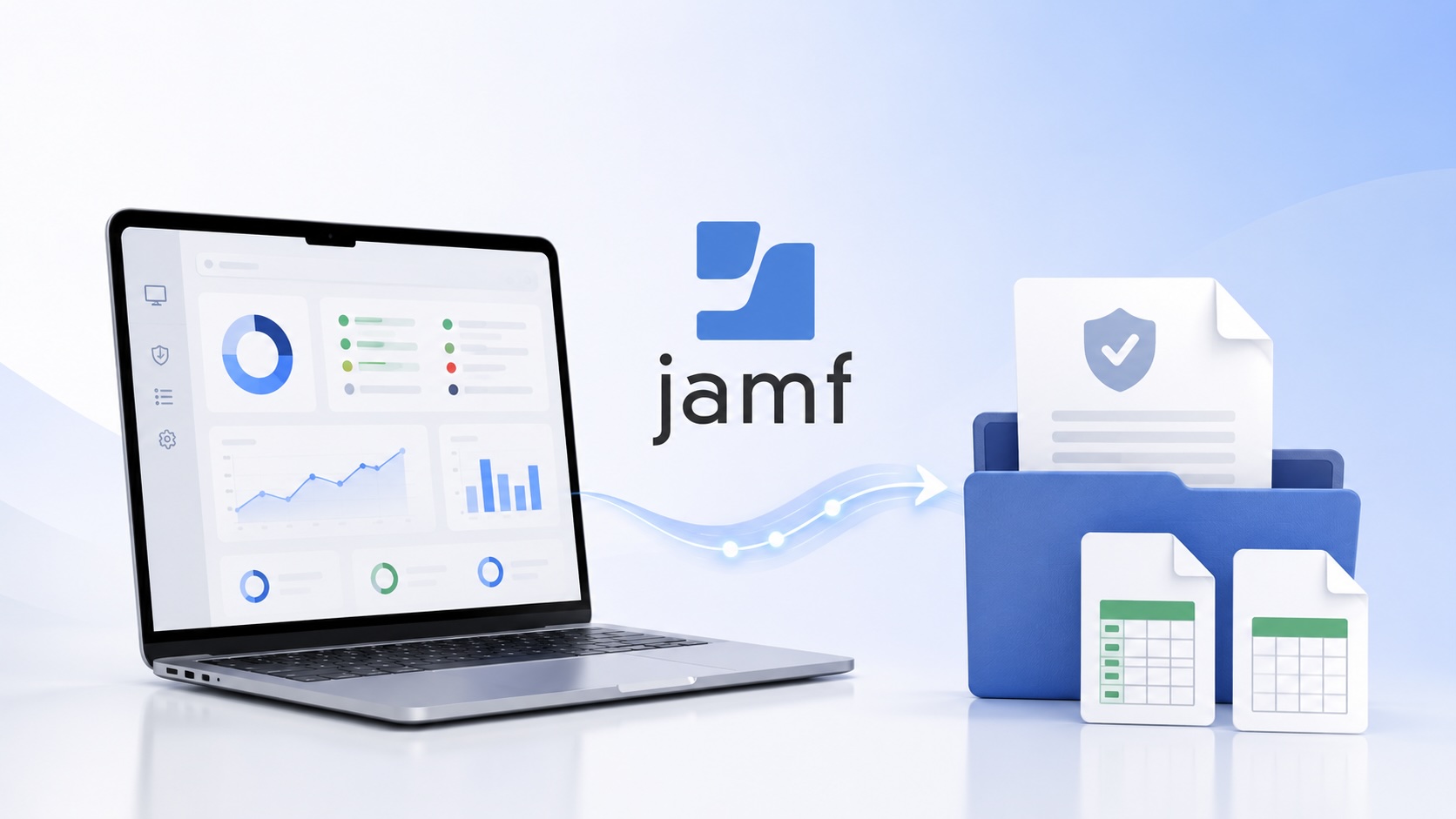
How Jamf Compliance helped support the Mac portion of a CMMC assessment, and why I added a small read-only CSV summary script for auditor-ready failed-result evidence.

A replacement adapter finally brought my PowerBook 145 back to life, but the storage bay had a stranger problem than I first thought: the drive inside was an IDE drive, not the SCSI storage this machine needs. The surprise was that 6 MB of RAM made a System 7.1 RAM Disk boot possible while I wait on a replacement cable and BlueSCSI.
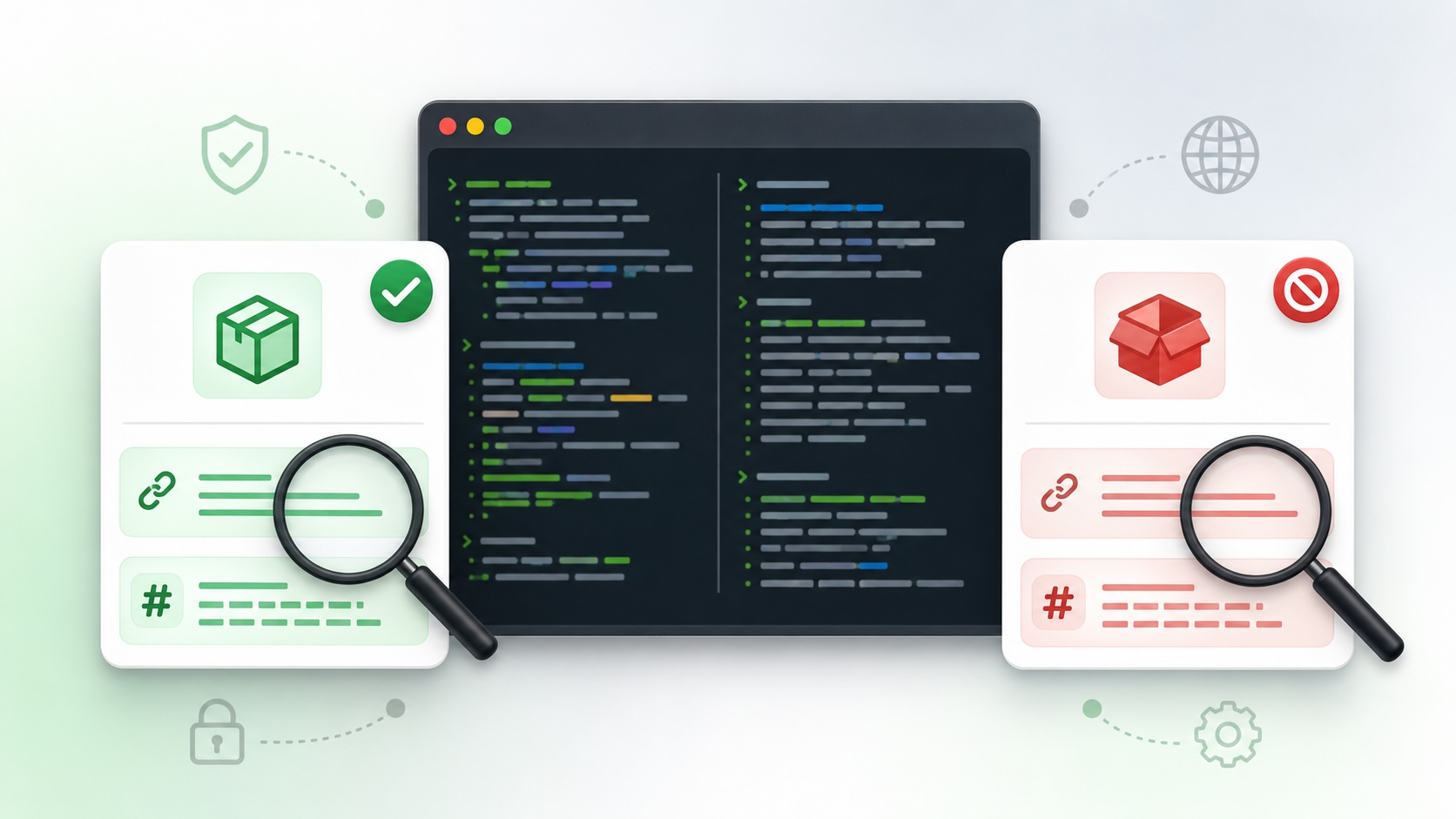
Homebrew gives Mac admins a useful first-pass inspection workflow before trusting a formula or cask: check the source, checksum, version, tap state, availability, and upstream maintenance story.
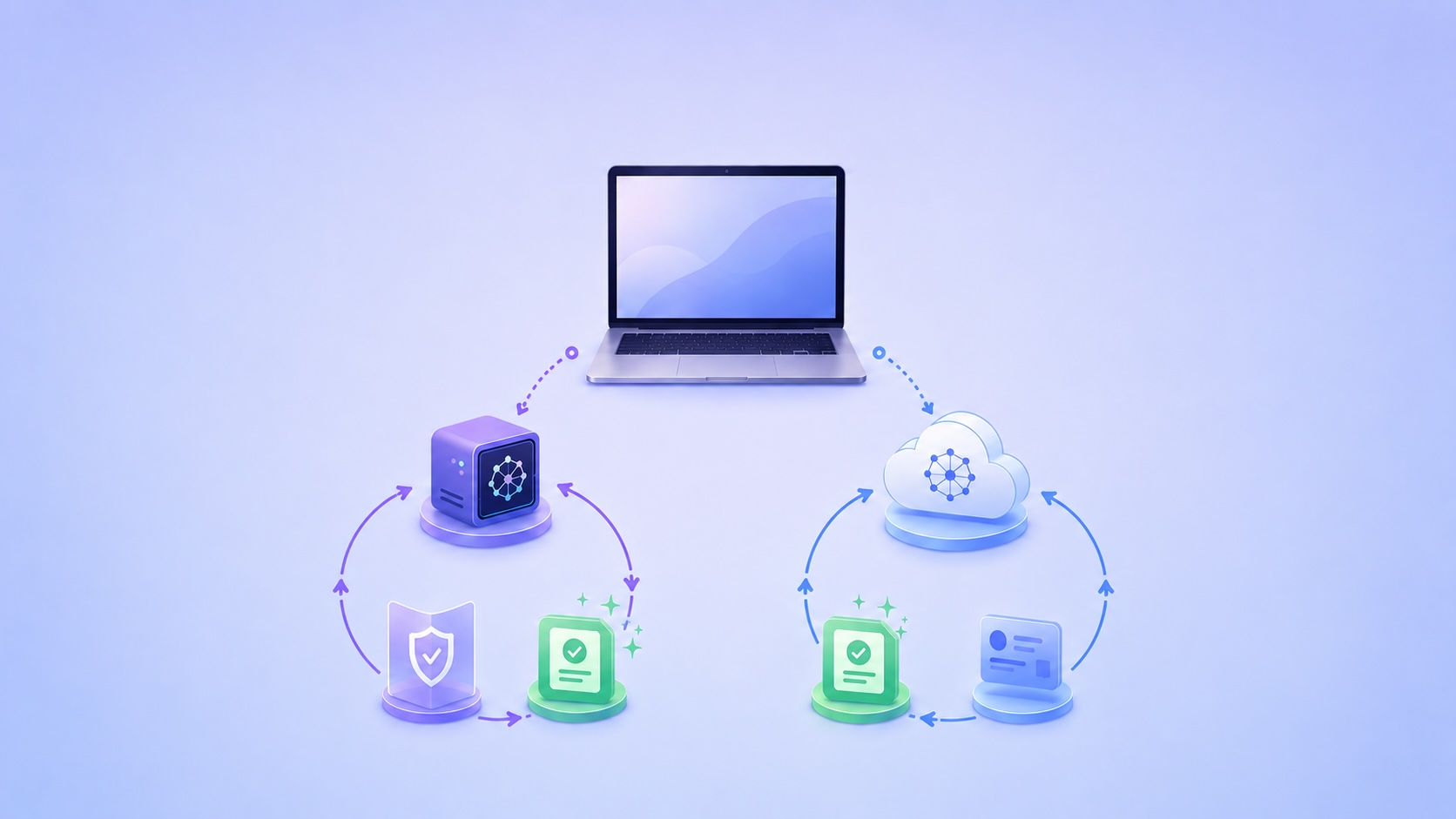
Running AI locally on a Mac has become a real part of my workflow, but only once I stopped treating local models like general-purpose answers and started treating them like constrained components inside a system I can still inspect.
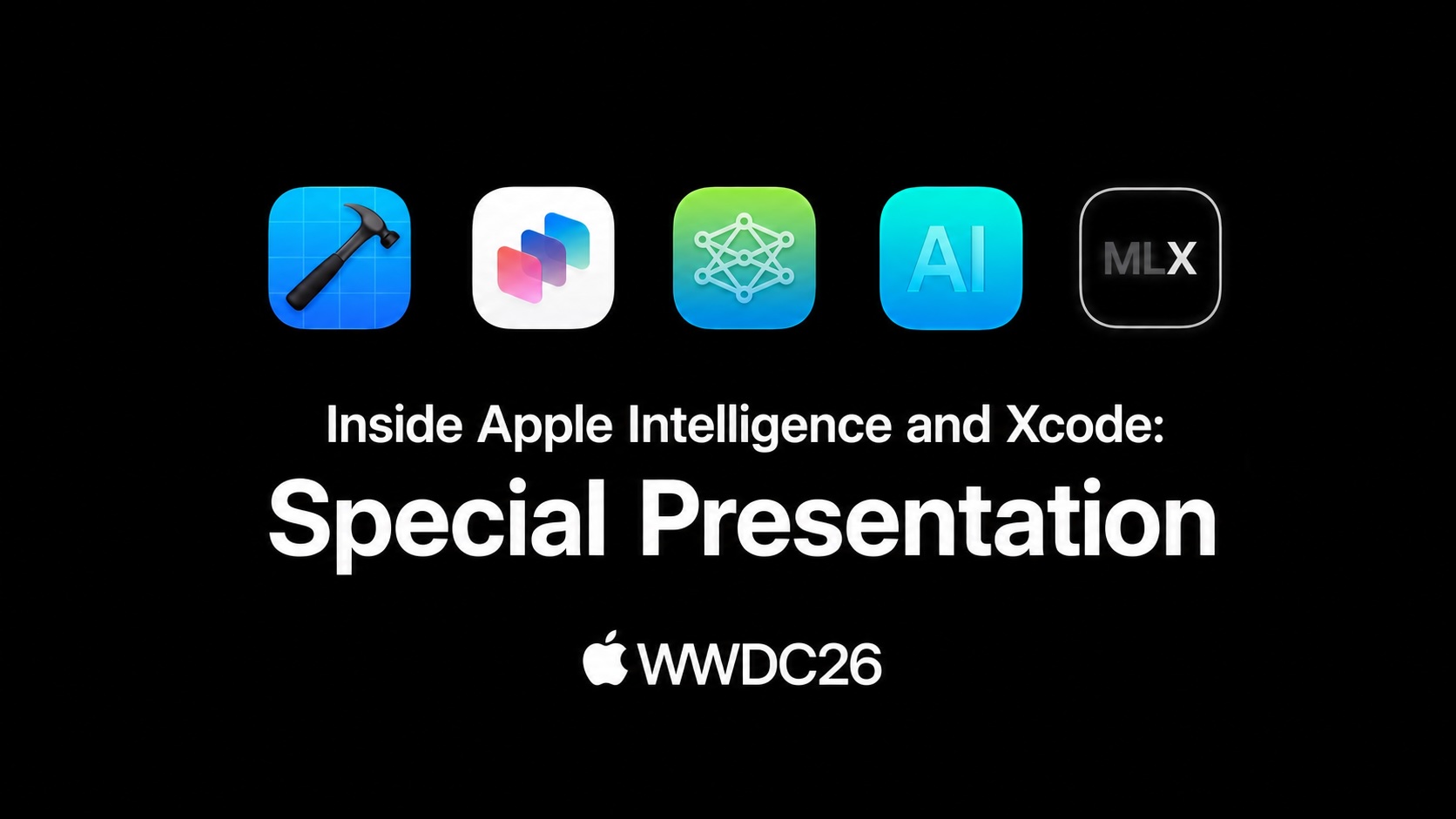
Apple’s WWDC26 special presentation on Apple Intelligence and Xcode was less about adding a chat box to developer tools and more about making AI part of the platform boundary. Xcode agents, App Intents, Foundation Models, Core AI, and MLX all point toward the same idea: intelligent features need context, permissions, testing, and clear ownership before they belong in production software.

I picked up a clean PowerBook 145 knowing it might be a gamble. What I found was a machine that looked promising on the outside, demanded the correct 7.5V power approach, revealed a torn hard drive ribbon cable inside, and still refused to chime. That first teardown ended up being less about a successful revival and more about the reality of vintage Apple restoration.
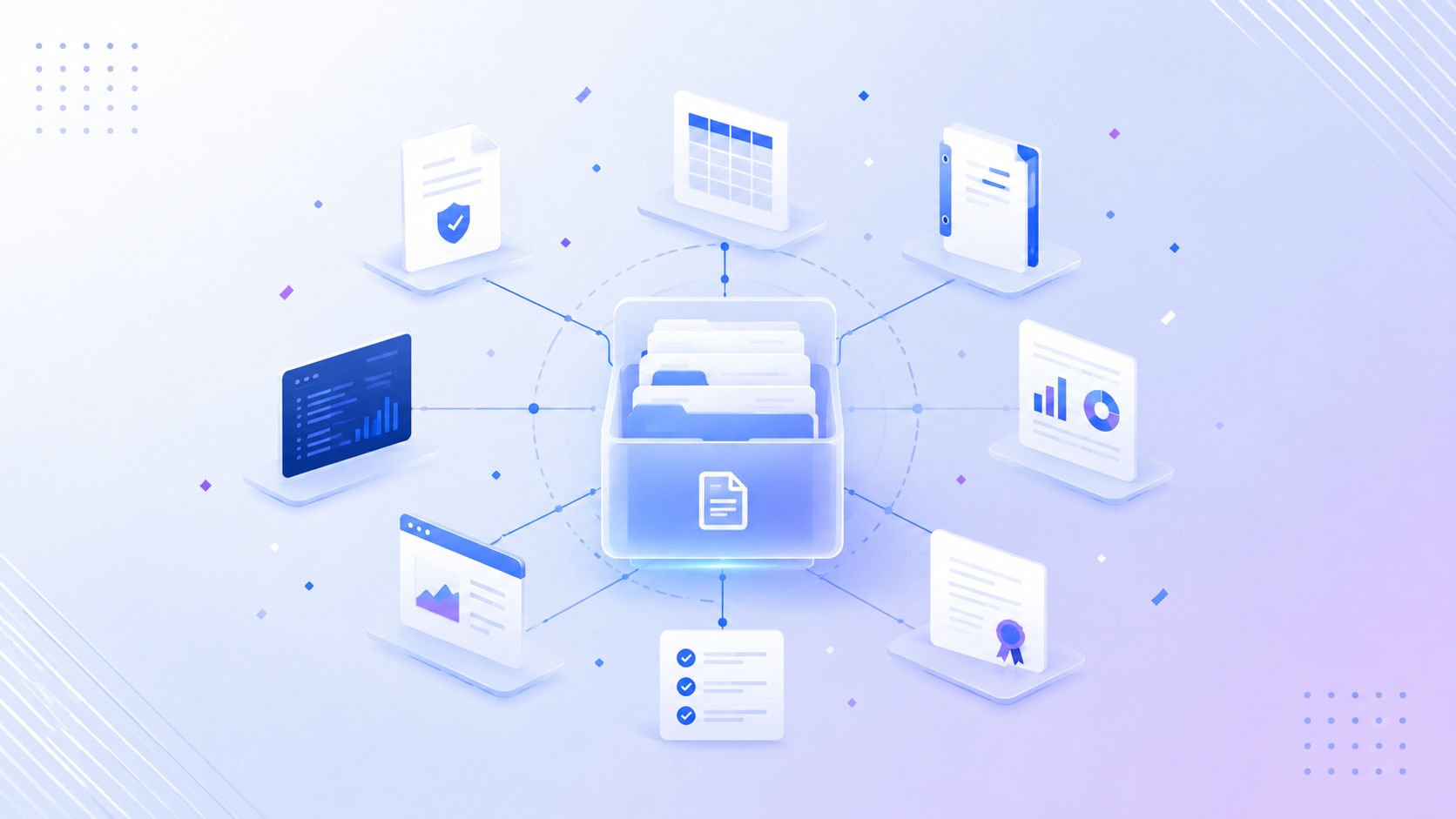
When I started preparing for a CMMC assessment, I expected to spend most of my time focused on policies, procedures, and the System Security Plan. Those things are certainly important, but what surprised me was how much of the assessment ultimately came down to evidence.
Most of those conversations eventually landed in the same place. Siri wasn't ready. Liquid Glass was everywhere. There was no new hardware announcement. Depending on who you asked, WWDC 2026 was either disappointing or forgettable.
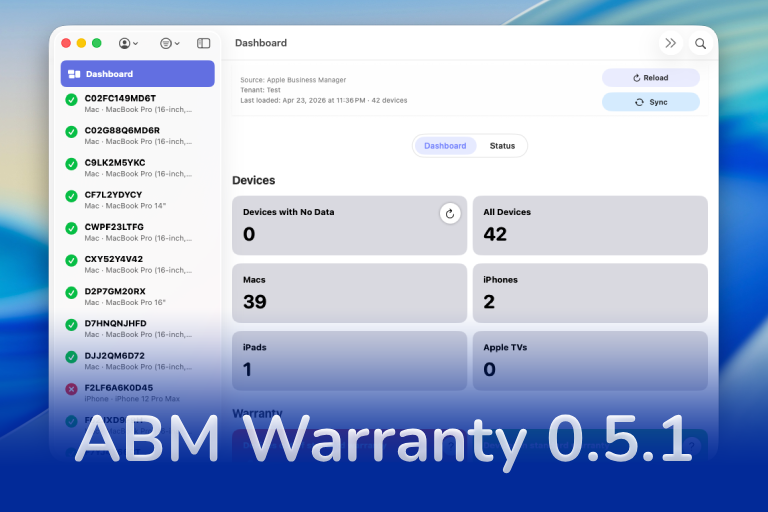
ABM Warranty 0.5.1 adds outbound connection workflows for JAMF and OAuth-based APIs, an expanded device detail view, outbound job tracking, and guide updates for connection setup and sync review.
After helping lead our organization through a successful CMMC Level 2 assessment, I share lessons learned from years of preparation, audit readiness, evidence collection, and working through the certification process.

Build beautiful macOS Help Books with live preview, multilingual AI translation, and one-click export to Helpbook, PDF, and HTML.
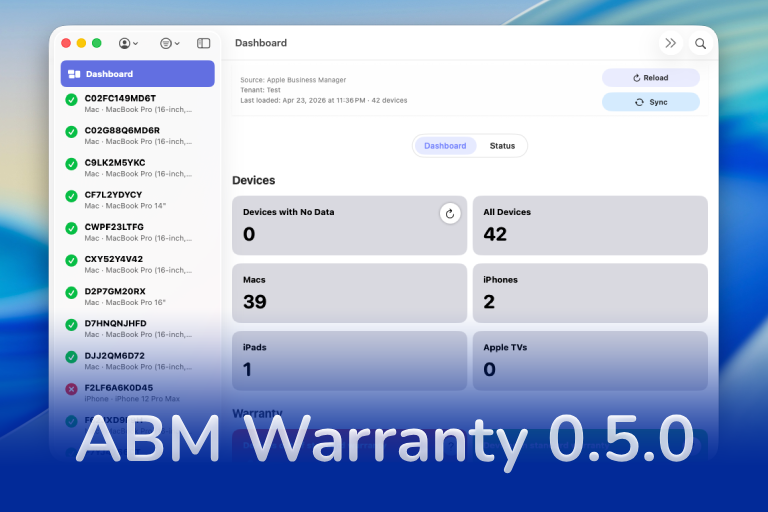
ABM Warranty 0.5.0 expands the platform with tenant-aware desktop widgets and notifications, giving teams clear, real-time visibility into fleet health, expiring coverage, and devices requiring attention across ABM/ASM environments. This release introduces a powerful CLI for managing notifications and sync workflows, alongside a new job-based architecture with chunking, sync history tracking, and an enterprise sync mode designed to scale with large device fleets. Additional enhancements include API credential rotation for security-conscious organizations, notification muting for known exceptions, forward-compatible database migration paths, and full localization support across 10 languages for global...
Apple has quietly turned Apple Business Manager into something much broader than the device enrollment portal many of us have known for years. The new experience feels cleaner, more organized, and much more intentional. After spending time with the latest Apple Business documentation, my first reaction is that Apple is building a more complete business platform — one that brings identity, services, communications, support, storage, and payments closer together under a single administrative surface.
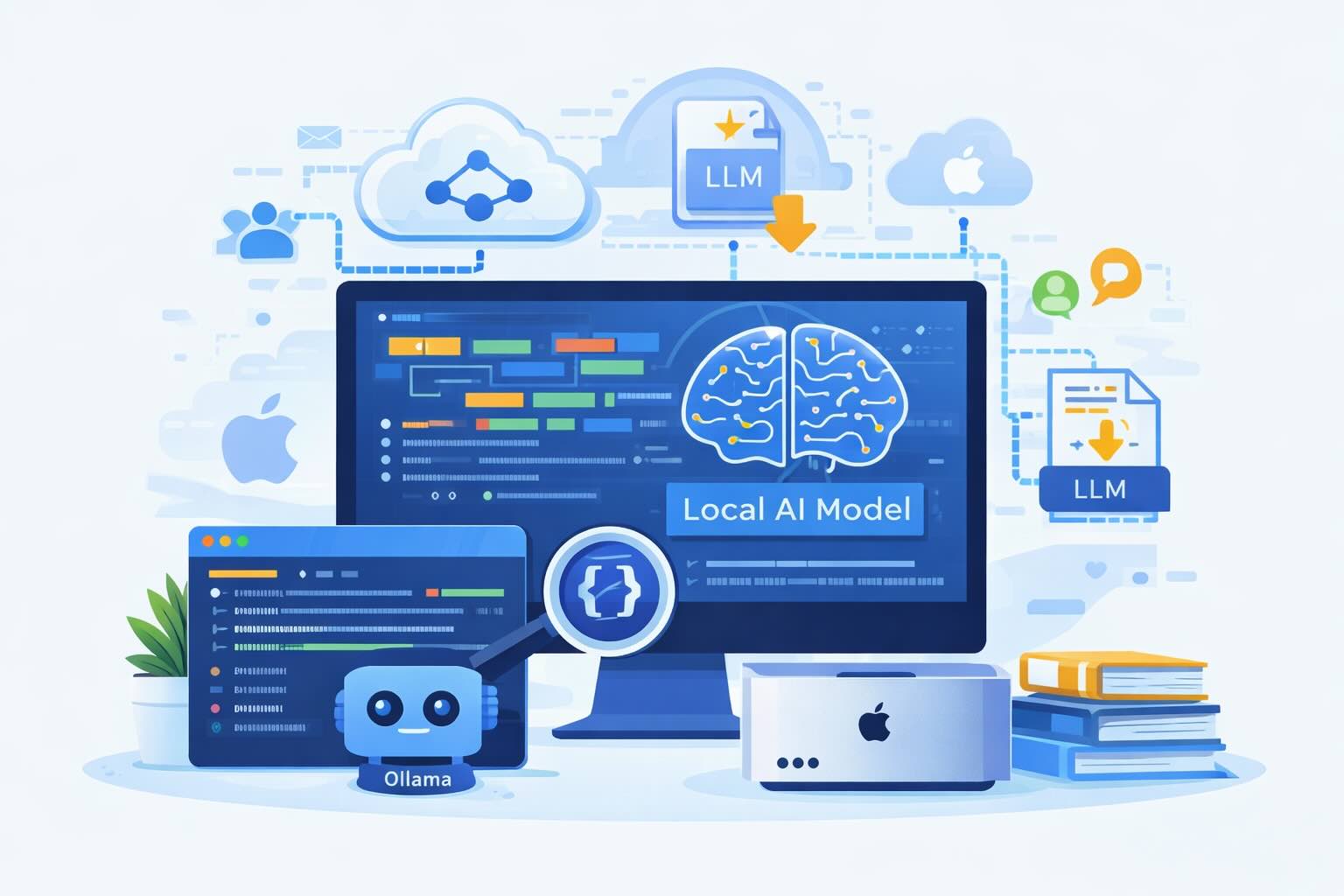
Recently, after some bad experiences with OpenAI's ChatGPT and CODEX, I decided to look into and learn more about running local AI models. On its face it was intimidating, but I had seen a lot of people in the MacAdmins community posting examples of macOS setups, which really helped lower the bar for me both in terms of approachability and just making me more aware of the local AI community that exists out there today.
I really feel like in this era of AI it's essential to write about and share experiences for others who are leveraging AI, especially now that AI usage seems almost ubiquitous. Specifically, when it comes to AI in development and the rapid growth of AI-driven automations in the IT landscape, I believe there's a need for open discussion and exploration.
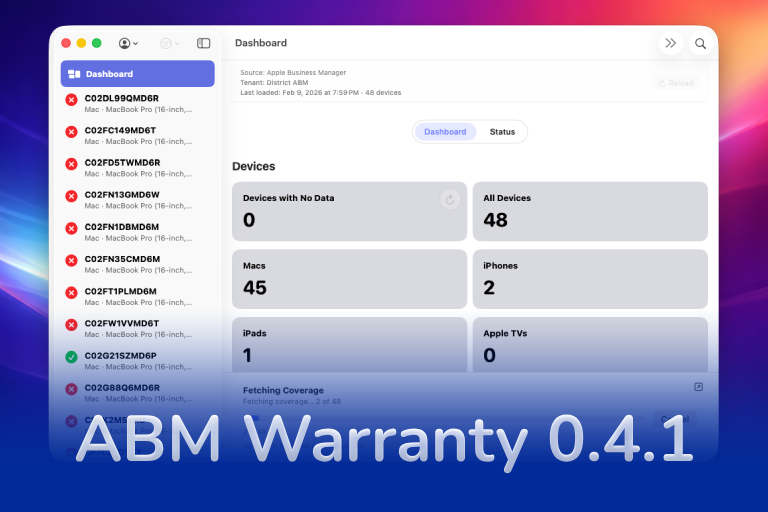
The 0.4.x release series for ABM Warranty is focused on operational scale. The earlier 0.3 releases were about trust, correctness, and stabilizing the foundation. Version 0.4.1 builds directly on that work by making the app more practical for consultants, internal IT teams, and managed service providers who need to support multiple environments without losing isolation, control, or visibility. This includes improvements to user interface and workflow, as well as enhanced reporting capabilities to help these users manage their workflows more efficiently.

So there I was, a typically day, a typical weekend. As a ChatGPT customer, I had heard good things about Codex and had not yet tried the platform. To date my experience with agentic coding was simply snippit based support with ChatGPT and Gemeni where I would ask questions, get explanations and support with squashing bugs in a few apps that I work on, for fun, on the side. There were a few core features in one of the apps I built that I wanted to try implementing but the...
Download ABM Warranty
Security and risk are often treated as interchangeable concepts in modern IT environments, but they are not the same discipline. Security focuses on controls, enforcement, and prevention. Risk management, by contrast, is concerned with likelihood, impact, and consequence across operational, financial, and organizational domains. Frameworks such as those published by NIST make this distinction explicit: risk assessment is not a technical exercise, but a business one. Technology informs risk decisions, but it does not define them.
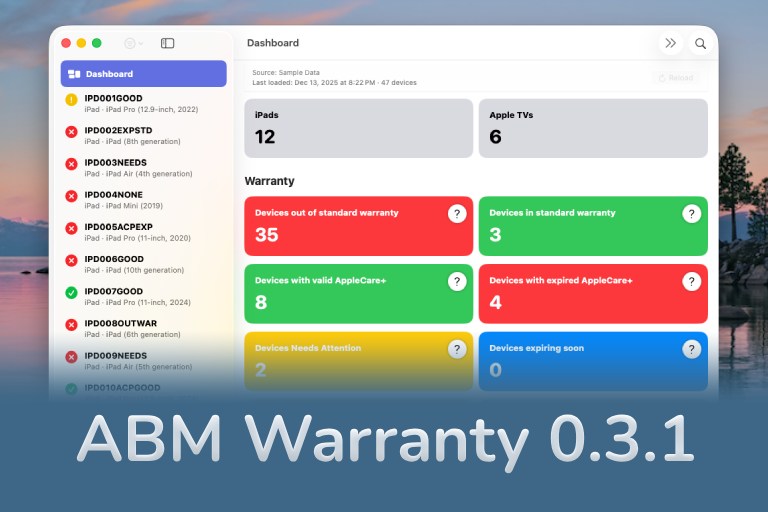
The 0.3.x release series for ABM Warranty is about tightening guarantees. Where earlier releases focused on surfacing data and making long-running operations observable, 0.3.x focuses on ensuring that what you see is complete, consistent, and safe to trust—particularly as the app is used in larger, slower, and more varied environments. This shift in focus aims to provide a more reliable foundation for users who require higher levels of assurance from their warranty management system.
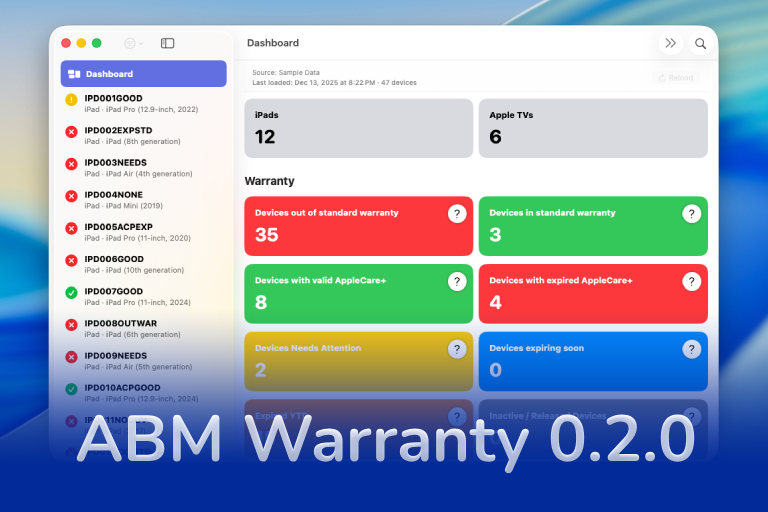
ABM Warranty 0.2.0 is a feature release focused on visibility, safety, and scale. This version does not change what ABM Warranty is meant to be, but it significantly improves how the app behaves under real-world conditions—large device counts, API throttling, long-running imports, and the kinds of failure modes Apple IT admins actually encounter. The improvements in this release are designed to make the app more reliable and efficient, allowing it to handle complex scenarios without breaking or becoming unresponsive.

Shipping software in isolation is comforting. You control the inputs, the environment, and the narrative you tell yourself about how things work. The moment you invite other people in—especially people who don’t share your assumptions—you lose that comfort. You also gain something far more valuable. Running a public beta for ABM Warranty through Apple’s TestFlight program forced me to confront that tradeoff head-on, and it fundamentally changed how quickly and confidently the app matured.
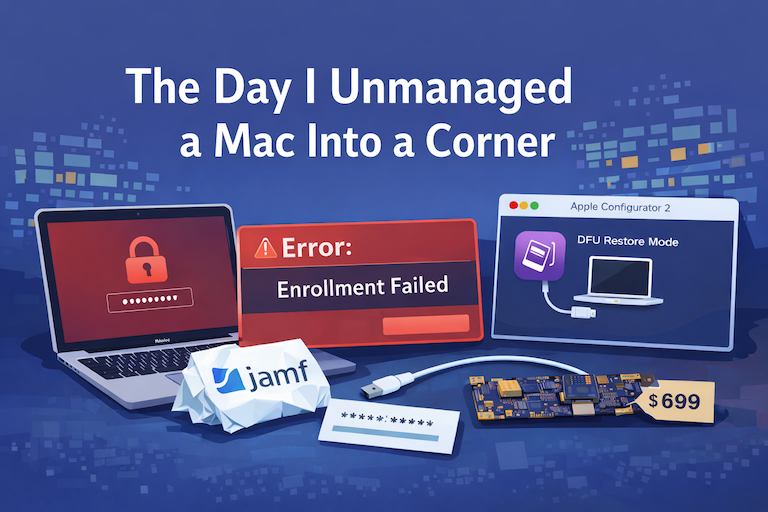
There are a few kinds of mistakes you make as a Mac admin. There are the ones that cost you time, the ones that cost you sleep, and then there are the ones that leave you staring at a perfectly good laptop thinking, “How did I possibly make this *less* manageable by touching it?” These mistakes often stem from a lack of understanding or experience with macOS, but they can also be the result of rushing through tasks or not taking the time to properly plan and test.
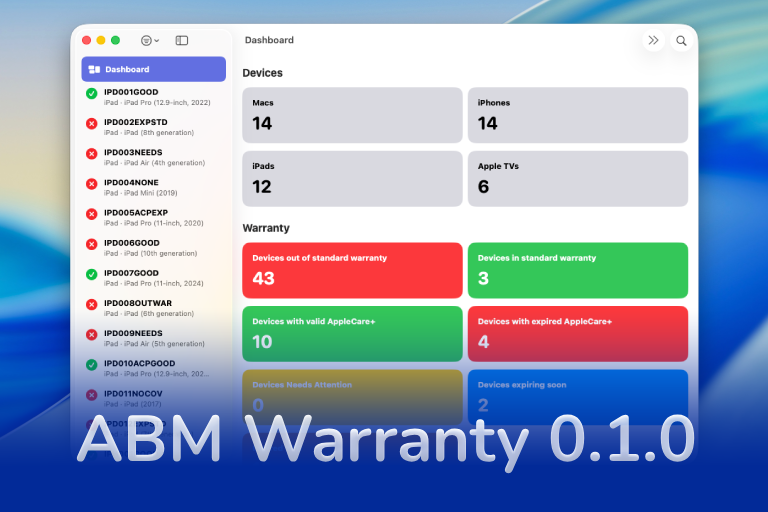
If you manage Apple devices at scale, you already know that **Apple Business Manager (ABM)** provides warranty data — but in practice, it’s extremely limited. It doesn’t provide workflow-friendly insights, it doesn’t surface actionable coverage states, and it doesn’t help you wrangle the ever-growing complexity of **AppleCare+ renewals** across hundreds or thousands of devices. This lack of comprehensive information can lead to missed renewal deadlines, unnecessary costs, and a higher risk of device downtime due to expired warranties.
If you’ve ever tried to talk directly to the **Apple Business Manager (ABM) API**, you already know the process can feel like deciphering a secret code. Between private keys, encrypted certificates, ES256 signatures, and OAuth2 flows... there’s a lot going on under the hood. This complexity is what makes direct communication with ABM so challenging, requiring a deep understanding of its intricacies to navigate successfully.

Keeping Safari updated is one of the simplest ways to harden a macOS fleet. Apple ships security fixes for Safari frequently, and those patches often land before a full macOS point release. This means that by keeping Safari up-to-date, you can ensure your users have access to the latest security protections without having to wait for a major operating system update. If Safari is lagging behind, your users are browsing the web with a larger attack surface than necessary.
If you've spent enough time living inside Jamf Pro, you eventually run into the same problem: someone set a configuration somewhere, sometime, and nobody remembers where. It might be something obscure – a certificate payload, a conditional SSO predicate, or that one security preference quietly misbehaving on three machines in accounting. And when you have dozens of configuration profiles, each with multiple payloads, nested keys, and XML-wrapped values, finding that setting can feel like forensic archaeology.
When I first wrote about troubleshooting Standard Routing Policies in Jamf Security Cloud, the goal was simple: help admins keep Microsoft Teams and Microsoft 365 traffic flowing smoothly through Jamf Trust + App-Based VPN. This straightforward objective remains unchanged, as the complexities of network configurations can often lead to frustrating issues that hinder productivity.

When you run a consultancy, you think the job is about your expertise—the thing you’ve been hired to do. But very quickly, you realize the role demands a whole set of skills you never set out to master. They sneak in over time, and before you know it, you’ve become fluent in things you once thought you’d avoid. The funny part is, you don’t even notice you’re learning them until you look back and recognize how much your approach has shifted. These are the skills that never appear on your...
I have a lot of friends in the job market right now, and we’ve been having some interesting conversations about a title that comes up again and again: “Senior.” It’s one of those words that carries weight when you first hear it—implying a certain level of mastery, trust, and authority—but the more you look at how it's used in practice, the more slippery it becomes. We've been debating what exactly "senior" means in different contexts, from years of experience to specific skills or responsibilities.
When I recently passed the Apple Certified Support Professional (ACSP) exam again, I paused to reflect — not just on this milestone, but on the long path I’ve walked through Apple’s certification landscape. My first certification dates back to macOS 10.5, and over the years, I’ve earned credentials across nearly every version since. In that time, the exams — and Apple itself — have transformed significantly.
Keeping your organization's VPN always connected is crucial—especially with Zero Trust Network Access (ZTNA) frameworks like **Jamf Trust**. One of the challenges with **Jamf Trust** is that it does *not* automatically open or reconnect on startup or login by default. However, with a combination of Jamf Pro policies, a custom script, and an extension attribute, you can ensure your users stay securely connected at all times, even when their devices are restarted or logged out. This setup helps maintain continuous access to network resources while adhering to the security standards...
As a fairly new administrator of JAMF Security Cloud, it was the ease of which its administration that admittedly drew me in. Quite an elegant solution for securing the various apps on business workstations with premade app-based VPN routing rules built right in, I was hooked. The concept is simple: turn on the policies, create your enrollment, and deploy – and you're done. This straightforward approach has made it easy to integrate into our existing workflow, allowing us to focus on more critical tasks.
I started thinking about what it means to be a great IT technician. As one of my now roles, IT technician was thrust upon me, among other things, by choice. Primarily because I enjoy it, and so it got me thinking, why do I love it so much? Over the years I have worn the hat of support specialist, web developer, IT manager, IT director, and CEO. I am now the information systems security officer but not matter how hard I try, the pull, and draw of troubleshooting issues pulls...
I’ve written about how I’d build an MSP from scratch in 2024. I followed that up with what I’d do differently in 2025 after a few more battle scars. Now, as I reflect on the way this space keeps evolving, I think it’s time to talk about scale—and more specifically, how not to lose your mind while scaling. It's an area where many MSPs struggle, and I'm no exception.
Managing Secure Tokens on macOS has long been a challenge for administrators using JAMF and Automox. In my previous post, Managing the macOS Secure Token with JAMF Pro, I discussed a script-based approach to grant Secure Tokens to additional users. However, this method required administrators to manually pass usernames and passwords into the JAMF configuration—an approach that, while effective, was not ideal from a security or usability perspective. This manual process introduced unnecessary risks and added complexity to the overall management of Secure Tokens.

As 2025 begins, it’s a fitting time to reflect on the transformative journey I’ve undertaken over the past few years. It’s been a whirlwind, filled with growth, learning, and exciting challenges.

Cybersecurity is no longer a luxury or an afterthought—it's an absolute necessity. But how can you tell if the company you work for, as a security professional, truly values cybersecurity? Let's explore some clear indicators that demonstrate a company's commitment to implementing robust security practices in-house. A genuine commitment will be reflected in the organization's policies and procedures, which should be regularly reviewed and updated to address emerging threats.

In the IT field, certifications often appear to be the golden ticket and in many cases the fast track to success. They signal expertise, validate skills, and provide a sense of accomplishment. However, the heavy reliance on certifications in the industry brings a host of challenges, and many professionals, like myself, find themselves questioning the value, timing, and necessity of these credentials. This has led to a culture where some individuals prioritize certification over hands-on experience, while others feel pressured to constantly update their credentials to remain relevant.
As more professionals leave the security of full-time employment to pursue consulting, the idea of starting your own business becomes both inspiring and daunting. While the freedom to shape your career and work on your own terms is alluring, it’s critical to understand that building a successful consulting business involves significant planning, preparation, and risk. This transition requires careful consideration of financial stability, market demand, and personal goals, as well as a willingness to adapt to changing circumstances and unexpected setbacks.
In 2014, I embarked on a journey that would shape the next eight years of my life. With a vision in mind and a determination to succeed, I founded Grove Technologies, a Managed Service Provider (MSP) based in Maryland, focused on delivering exceptional IT solutions to businesses of all sizes. The company grew steadily, overcoming challenges and celebrating milestones, until 2022, when I decided it was time to pass the baton and sold the business. It was an incredible experience, filled with invaluable lessons, but as I reflect on those...
Its been a while since I have used Automox, but the premise of the tool is that it automatically patches your macOS, Linux and Windows workstations. for macOS it does this using a service account created with username _automoxserviceaccount and this account needs a secure token. The issue here is that when the package is deployed the secure token is not transferred to that account which means that it most cases it can't apply macOS updates.
From 2014 until 2022 I built and ran a series of successful IT consultancies, from a one person solopreneurship (Jon Brown Consulting), to a startup (Mac Gurus) that grew rapidly but faced significant challenges, to its more mature and accomplished predecessor (Grove Technologies) where I eventually sold the business and exited the industry.

In the fast-paced realm of consultancy, where competition is fierce and innovation is key, finding the delicate balance between competition, collaboration, and cooperation is essential. Today, we embark on a journey to explore the transformative potential of collaboration in the consultancy world.

In the dynamic landscape of leadership, the role of a mentor holds paramount importance. The ability to guide, inspire, and empower team members is fundamental to fostering a thriving work environment. However, what happens when a manager is tasked with both managerial responsibilities and the role of a mentor? This delicate balancing act is riddled with challenges and complexities. In this blog post, we'll explore the perils and pitfalls of being both a manager and a mentor and discuss effective strategies to navigate this intricate terrain.

Partnerships can change the trajectory of a business, but only when they are built around real value rather than vague optimism. In practice, the best collaborations do not happen because two companies simply like the idea of working together. They happen because each side brings something the other lacks, and because that relationship creates a better outcome for clients, operations, or long-term growth. This requires a clear understanding of what each partner can offer, as well as a willingness to adapt and compromise in order to achieve mutually beneficial results....
Today, I want to open up about a challenge that has been a constant companion on my entrepreneurial journey—the struggle to separate my personal feelings, passion, and drive from my day-to-day business operations. Early in my career, wearing my heart on my sleeve was an asset. It helped me connect with clients, foster deep relationships, and gain trust.

Training your staff is one of the most important investments a growing business can make. Hiring people creates capacity only if those people are equipped to work effectively inside your systems, understand your standards, and make sound decisions without constant intervention. Without training, growth usually creates more supervision, more inconsistency, and more pressure on the business owner. In fact, untrained staff can hinder progress, lead to mistakes, and even damage relationships with customers or clients, ultimately undermining the very goals you're trying to achieve through expansion.

Empathy is often treated like a soft skill that matters only after the real business work is done. In practice, it is one of the most important leadership tools a company has. When teams are under pressure, deadlines are slipping, and expectations are high, the instinct is often to push harder and assume that missed outcomes reflect a lack of effort. More often, the real issue is that people are carrying more than their workload makes visible.

In the fast-paced world of entrepreneurship, where every decision can determine the fate of a venture, there's a fundamental truth that stands tall amidst the chaos: community isn't just an aspect of business; it's the very essence of it. As I traverse my entrepreneurial journey, I've learned that community isn't merely a support system; it's the heartbeat of a thriving business, shaping its identity and trajectory in profound ways.

Delegation is one of the clearest signs that a business is maturing beyond the founder’s personal capacity. Many owners think of delegation as simply handing off tasks, but in practice it is a leadership decision that shapes how the business scales, how the team develops, and how much strategic room the owner has to think beyond daily execution. Effective delegation requires clear communication, defined roles, and a willingness to let go of control, allowing the business to grow more efficiently and sustainably over time.

One of the hardest lessons in entrepreneurship is learning that control is not the same thing as leadership. Early in a business, doing everything yourself can feel necessary. You are close to the work, you care about the outcome, and it's easy to believe that the best results only happen when you manage every detail personally. As time passes, this mindset becomes a limit rather than a strength, hindering growth and progress.

In the world of entrepreneurship, every milestone achieved is not just a triumph but a testament to the journey of growth, resilience, and evolution. Today, I want to take you on a deeply personal and transformative chapter of my entrepreneurial expedition—a journey that took me from being a solopreneur to a team leader.
Innovation is often described as a creative spark, but in business it is usually the result of making deliberate decisions that break from habit. Entrepreneurs who build something meaningful rarely do it by copying the safest available template. They do it by seeing a gap, taking a calculated risk, and building in a way that reflects a clearer point of view than the market has seen before. This approach requires a willingness to challenge conventional wisdom and adapt to changing circumstances, rather than simply following established patterns or seeking shortcuts....

In the vast tapestry of life, we often find ourselves ensconced in the comforting embrace of the familiar. It’s easy to get accustomed to the routine, to revel in the known. But what if I told you that real growth, the kind that transforms us into the best versions of ourselves, lies just beyond the borders of our comfort zones?
Budding a business is hard. It takes lots of determination, it will enlist you into long hours and long nights and weekends with the family missed. Its a huge commitment and an in turn a huge part of your life, which is why if your going to go down this path that you do it under the realization that you are enjoying the process, and take time to have fun long the way.

Let's talk a moment about the link between brand and business growth. The brand of your business is the face of your company, how it projects itself, and how it's perceived in the marketplace. A strong brand identity can establish trust with customers, differentiate you from competitors, and ultimately drive revenue growth.

One of the things that really was a cornerstone of my success as a business owner and operator was the understanding that client retention is not only closely tied to client satisfaction and relationship building, but it's also very much partnership driven. Early on I was able to partner with clients that I really admired, and in doing so, pushed me to become a company that others would also admire. This approach allowed me to build trust and credibility with my clients, which ultimately led to long-term relationships and repeat...

Setting big goals is one of the clearest ways to force a business out of maintenance mode and into real growth. Without ambitious targets, it becomes easy to focus only on what is familiar, manageable, and immediately in front of you. That may keep the business stable for a while, but it rarely creates the kind of progress that changes what the company is capable of. In fact, setting small goals can even lead to stagnation, as employees become too comfortable with the status quo and lose motivation to innovate...

Mark Cuban, the renowned entrepreneur and investor, affirms, "One of the keys to my success undoubtedly was and is my attention to detail." Attention to detail is one hundred percent a learned skill. In my experience, those who work with and in the technology industry ultimately learn early on the importance of embracing technology as part of their overall day-to-day operations. This includes staying up-to-date with the latest tools and software, and being willing to adapt to new technologies as they emerge.

As a new business owner and operator I had to be creative with looking for ways to add value to my client services offering. One of the things that has been so successful for me has been my ability to build long lasting relationships with clients over time. The ability to earn trust and establish relationships is a set of soft skills that enhance the overall success of the business. Its for sure a strategic tool but if left unchecked can become your businesses biggest liability. A business, client relationship...
Startup planning matters, but one of the biggest mistakes founders make is treating the original plan as if it should remain fixed. A business plan is most useful when it helps you make better decisions in the present, not when it becomes a document you are afraid to revisit. The reality is that markets change, customers change, and your own understanding of the business changes as you gain experience. In fact, revisiting and updating your plan regularly can help you stay adaptable and responsive to these shifts, rather than getting...
Good business sense, and amazing customer service are the foundation of good business, however to scale you need sales and to get sales you need to get your name out there. Advertising and marketing will only get you so far and yes brand and company story are valuable tools to garner interest but the fastest way to grow your business is through word of mouth referrals. This means focusing on building relationships with customers, providing value beyond their initial purchase, and encouraging them to share their positive experiences with others....

It shouldn’t be a huge shock, but almost all companies started are a byproduct of a side hustle. A side hustle is working after your primary job on something you're interested in for additional money or fun. This can take many forms, such as freelancing, selling products online, or offering services to friends and family.

I still remember it vividly, one day my phone rings and it's one of my clients letting me know they had a friend who worked at a company that they felt could really use my services. Great, I got the information and went in to see the potential new client. The meeting was brief, but it gave me an opportunity to learn more about their needs and how I might be able to help them.

Getting a first client is often described as a sales milestone, but in my experience it had far more to do with relationships than marketing. Long before I was building my own business, I was working as an IT director at a graphic design and digital marketing firm. The company sublet part of its office space to smaller startups, and part of my role was supporting those teams as well. I helped keep their internet working, made sure conference rooms were functional, and handled the day-to-day technology issues that made...

Starting a business is often less about knowing exactly what to do and more about deciding that uncertainty is not a good enough reason to stay still. One of the biggest mistakes new founders make is assuming they need to understand every part of business before they begin. In reality, that kind of overplanning can become its own form of fear. This mindset can lead to paralysis by analysis, where the desire for perfection holds you back from taking action at all.

Starting a business is often framed as a leap of faith, but one of the most important parts of building something real happens before the leap itself. The validation phase is where an idea starts to prove whether it resonates with other people. It is the stage where you test not only whether the concept makes sense to you, but whether it creates genuine interest, energy, and trust with the people who may eventually become your first customers.
If you work in the Apple IT space, the MacAdmins community is one of the most valuable professional resources available. It is a place where people share knowledge freely, help each other solve real-world problems, and make it easier for both new and experienced admins to keep growing. That kind of community does not sustain itself by accident, and that is exactly why the MacAdmins Foundation matters. The foundation plays a crucial role in supporting this ecosystem, ensuring that the community's efforts continue to benefit from resources, guidance, and collaboration....

One of the easiest mistakes to make when starting a company is choosing a name too quickly. In the earliest days, it is tempting to pick something that feels obvious, personal, or closely tied to the work you do right now. That kind of speed can feel productive, but a business name has to do more than sound good in the moment. It has to hold up legally, represent the company clearly, and leave room for the business to grow.

One of the most important shifts in entrepreneurship is learning that revenue is a result, not the foundation. A business obviously needs customers and it needs to make money, but when money becomes the primary focus of every decision, clients can usually feel it. The strongest businesses are not built by chasing transactions alone. They are built by creating an experience people trust and want to return to. This means prioritizing relationships over revenue, and investing in long-term growth rather than short-term gains.

Organizations are faced with the increasing scrutiny of more complex and sophisticated attacks by threat actors against key information systems that are essential to the organization. Complex attacks such as ransomware and data exfiltration are being used against organizations or systems that they encounter or somehow get access to. When an attacker wants to break into a system, they will typically choose the easiest and most direct methods in means in order to access it. The problem is an organization may not have a full understanding of the complex attack...
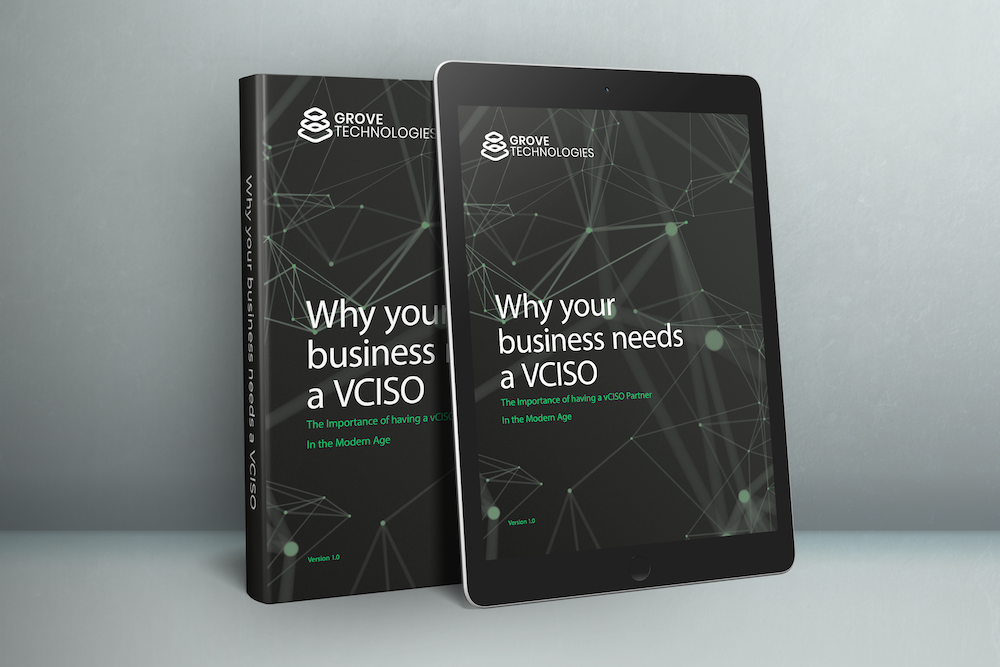
Cybersecurity risks and threats are issues that all organizations, large and small, must deal with. Whether the issues are information security program related or a technical challenge, organizations need to have the personnel resources to solve the cybersecurity issues as aligned to the business requirements set forth. In an ever-growing cloud-based services industry, information security risk is never greater. Cyberattacks are growing in impact and frequency. Not a week passes without a headline of another cybersecurity attack such as a data breach or a ransomware attack. Cyber criminals are becoming...

Security awareness training is one of the most critical and important security requirements for any size organization to consider implementing within their environment. Arguably, the greatest risk faced by any organization is the danger of insider threat as employees are can be considered a weak link in the chain as they are susceptible to curiosity, greed, envy, etc. To further increase risk, employees may be faced with the threat of social engineering attacks including phishing, baiting, spear phishing, tailgating, scareware, pretexting, quid pro quo, etc. To combat these risks, a...

A cyber security risk assessment is a critical activity performed on your company's security policy, procedures, and infrastructure to reveal potential threats to key corporate assets and vulnerabilities in your current security controls as implemented. This process involves identifying and evaluating the likelihood and potential impact of these risks, allowing you to prioritize mitigation efforts and allocate resources effectively.

The Cybersecurity Maturity Model Certification (CMMC) is the Department of Defense’s (DoD) latest cybersecurity program designed to ensure that cybersecurity controls and processes adequately protect Controlled Unclassified Information (CUI) that resides on Defense Industrial Base (DIB) systems and networks. The DIB consists of all suppliers of DOD related services including primes, subcontractors, consultants, and other entities that provide any type of service on a DOD related contract. This includes companies that manufacture, design, or test products for the DoD, as well as those that provide services such as logistics, maintenance,...

In November, Apple unveiled its new M1 chip and three new Macs that use it: the MacBook Air, 13-inch MacBook Pro, and Mac mini. The M1-based MacBook Air replaces the previous Intel-based MacBook Air, but with the 13-inch MacBook Pro and the Mac mini, Apple continues to sell some Intel-based models with beefier specs---most notably a higher memory ceiling. This dual approach allows customers to choose between the efficiency of the M1 chip and the performance capabilities of Intel processors, depending on their specific needs.

Even beyond its often controversial behavior in the 2020 US presidential election, Facebook continually makes news headlines for its numerous privacy and security problems. Most notable, of course, were the 50 million Facebook profiles gathered for Cambridge Analytica for the 2016 election. Closer to home, the company pushed a VPN service in the Facebook iOS app that collected all your mobile data traffic for Facebook. After pressure from Apple, Facebook pulled the VPN but reused it for the Facebook Research program, which paid users as young as 13 for their...

In 2018, Apple dropped support for creating print projects from within Photos, including greeting cards, calendars, and books. Instead, Apple allowed other print-service companies to build Photos Project extensions that gave users the same sort of capabilities. At first, these third-party solutions didn't match up with what Apple had previously provided, but they've improved over time as developers have refined their offerings.

Many of us have been using iPhones for years, and apps we bought or downloaded long ago molder in corners of our Home screens. Even if you haven't played Flappy Bird in years, its pixelated icon still stares glumly at you every time you peer at its Home screen, and it's far from alone. To find out how many apps you have, go to Settings > General > About and look next to Applications. So where are they all?

For those who work in organizations, regardless of size, you know how much effort is involved with coordinating a group's technology. It can take quite some time to set up a new Mac, iPad, or iPhone with all the right apps, settings, and logins. And that's just to get started---on an everyday basis, maintaining solid security practices is essential, and support requests are inevitable. This process can be particularly challenging when dealing with multiple devices and users, requiring constant updates and troubleshooting to ensure everything runs smoothly.

On the Mac, nearly every file has an *extension*, a set of characters after a period that indicates what type of file it is and determines which app opens it. So, **.png** indicates a PNG graphic that opens in Preview by default, **.pages** denotes a Pages document, and **.docx** identifies a file as belonging to and opening in Microsoft Word. Plus, the extension for all applications is **.app**. Depending on what you do, how often you exchange files with people on other platforms, and your personal preference, you may wish...

The holiday shopping season is fast approaching! Given the significant stresses placed on society's fulfillment, distribution, and delivery systems by the pandemic, we recommend you start thinking about your holiday gift-giving sooner rather than later. Even Apple, which generally does an excellent job predicting demand and shipping products quickly, has been suffering from delays this year. But if you order in time, Apple has a wide variety of products that would make great gifts for your Apple-using loved ones.

With the release of the next OS from Apple, macOS 11 Big Sur, you may be tempted to upgrade right away and enjoy the newest features and sparkling new look of Apple's newest OS. With all the new features, it's tempting to hit that "Upgrade" button right away, but Grove Technologies is recommending that you wait until version 11.0.5 is released, which usually takes a few months. New versions of operating systems can be sluggish and buggy, they can slow down your Mac, and there are always compatibility issues with...

We all have things we do regularly on our iPhones, whether it's checking the weather, searching Google, or invoking the magnifier. Apple has long provided ways of making your most common actions easier to access. You might put an app on your Dock, open Control Center, or take advantage of the triple-press Accessibility shortcut. With iOS 14, Apple has opened up a new and customizable way of triggering actions: Back Tap.

Continuing its pandemic-driven approach of short, focused announcements, Apple once again took to the Internet to stream its "One More Thing" event. On center stage this time was the Mac, or specifically, three Macs, all of which replace the longstanding Intel chip with Apple's new M1 chip. The transition marks a significant shift in Apple's hardware strategy, one that has been years in the making. All three Macs can be ordered now and will be available within a week or so.
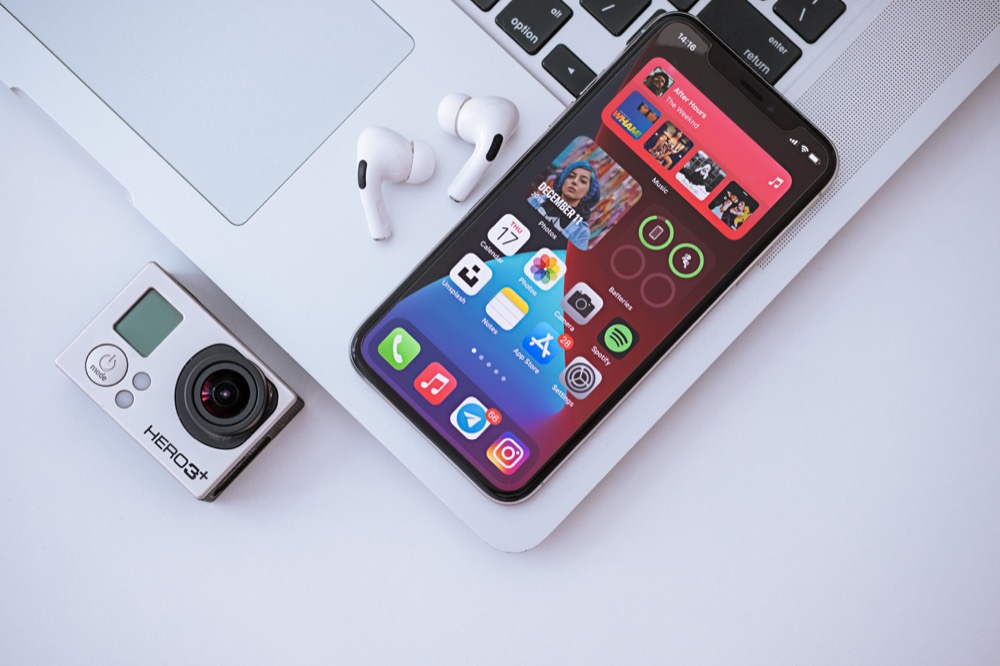
A significant new feature in iOS 14 is Home screen widgets, information-rich tiles that share space on a Home screen with app icons. iPhone users familiar with Google's Android smartphone operating system have long clamored for widgets because they provide quick information at a glance, without having to launch an app or swipe right on the Home screen for Today view. This feature allows users to access frequently needed information directly from their Home screen, streamlining their workflow and saving time.

When disaster strikes, your company needs to be ready. As the pandemic has shown in 2020, many small businesses were not ready for the scope and impact that a disaster may cause in terms of disruption and unavailability too critical systems and essential employees. Many small businesses were forced to scramble at the last minute to accommodate remote work solutions with the bare minimum preparation or experience to support continuity requirements. Small businesses should take into account the types of disasters that they may occur or impact their company. Here...

Cloud computing has taken the technology industry by storm in recent years, providing businesses small and large alike with convenient and cost-efficient solutions to store and share data. Platforms such as Amazon Web Services (AWS) and Microsoft Azure provide web hosting for some of the largest and most popular websites on the internet. Cloud Solutions are attractive options for small business owners, as they eliminate the need for spacious and expensive data warehouses and provide for fast and easy scalability. However, these new and evolving benefits are accompanied by an...

The modern office, small and large, have largely driven the practice of access to company data anywhere at any time. With COVID-19 forcing many companies to adopt a remote workforce, organizations must provide access solutions to their workers in order to safely and efficiently perform their tasks. The cost to provide organization provided devices can be expensive so the rise of BYOD (bring your own device) policies have largely given rise to the concept of using employee-owned devices to access organizational resources. This reduces the cost of equipment and reduces...

The small screen of the Apple Watch prevents new watchOS features from being as obvious or splashy as those in iOS and iPadOS. But watchOS 7, now available for the Apple Watch Series 3 and later when paired with an iPhone 6s or later running iOS 14, has quite a few notable changes. Here are our favorites: Family Setup, sleep tracking, handwashing reminders, and new watch faces and complications. These features may not be as flashy as some users might expect, but they demonstrate the continued evolution of watchOS to...

For the second time in less than a month, Apple has made a splashy announcement. In its "Hi, Speed" event, the company unveiled a new lineup of four iPhone 12 models, including the standard model, the Pro, and two additional variants with varying storage capacities. Alongside these devices, Apple also introduced the new HomePod mini.

In 2020, it seems like there is a new headline just about every week of another major company getting hit with a ransomware attack. Per the New York Times, "A woman died from treatment delays after a hospital in Germany hit by a cyberattack was forced to turn away emergency patients. Hackers released private information, including Social Security numbers, from a Las Vegas school district. A coronavirus vaccine trial was bogged down in recent weeks when researchers were locked out of their data." Adding to this you see major companies...
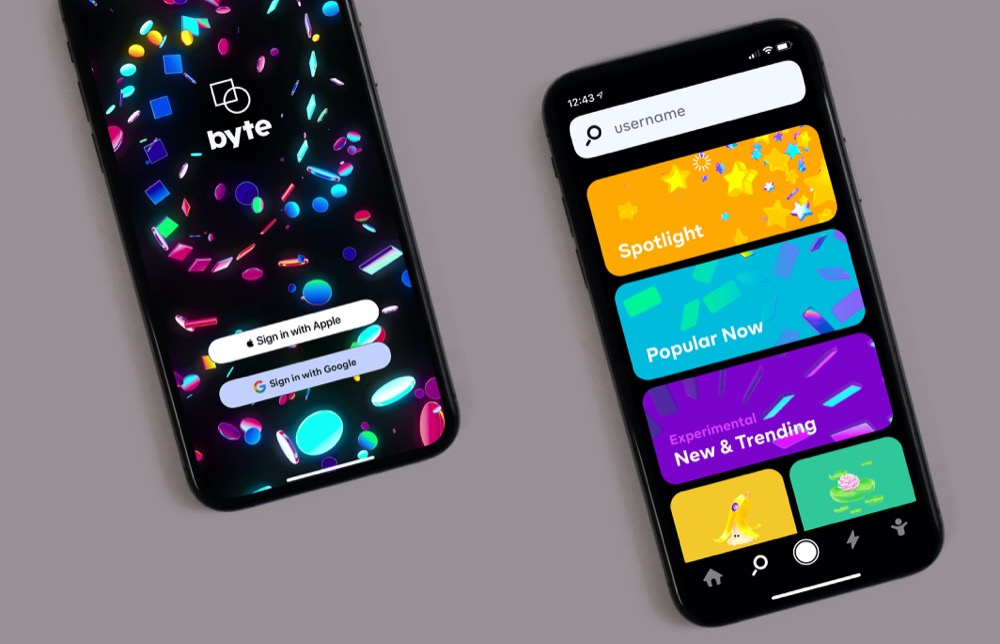
With over 30 billion app installs, Apple's App Store has seen significant consumer spending. According to the leading App Store analytics firm, this translates to a total of approximately $30 billion spent by users. This figure highlights the vast scale and commercial impact of the App Store on the mobile ecosystem.

In 2017 61% of small businesses in the United States suffered some kind of cyber-attack according to a report by the Ponemon Institute. This number reflects an over 50% increase year to year in cybersecurity assaults on U.S. small businesses. Even more discerning is that an August, 2020 report from Interpol is that 43% of small to mid-size businesses do not have any cybersecurity plans whatsoever. This includes no endpoint detection, malware detection, firewalls/basic defenses, and incident response/contingency plans.

Get CMMC Consulting Services From a Team of Compliance Experts and Cybersecurity Engineers Trained to Get You Over the CMMC Finish Line.

As we get into September, it's a good bet that Apple will soon---either this month or next---be pushing out major upgrades for macOS, iOS, iPadOS, watchOS, and tvOS. Apple previewed these new versions at its Worldwide Developers Conference back in June, and they've been in public beta for a few months. Once Apple makes macOS 11 Big Sur, iOS 14, iPadOS 14, watchOS 7, and tvOS 14 available, the question looms large---when should you install them?

Although Macs are great at managing their energy use, which allows MacBooks to maximise the time they are able to run from battery power alone, there are situations in which you may wish to extend their energy efficiency even further. This might be necessary when working on a project that requires prolonged periods of focus or traveling to areas with limited access to power outlets.

Over the last few releases of macOS, Apple has been beefing up the Mac's privacy controls so they more closely resemble what the company has done in iOS. You've undoubtedly noticed that when you first launch a new app on your iPhone or iPad, it often prompts for access to your contacts or your photos, the camera or microphone, and so on. The idea behind those prompts is that you should always be aware of how a particular app can access your personal data or features of your device. You...

Imaginatively called Apple One, you can now pay for a single subscription which will provide access to the following Apple subscription services: Apple Music, Apple TV+, Apple Arcade, and iCloud storage. This combined offering aims to simplify your digital life by consolidating multiple subscriptions into one convenient package.
Harvest season is here again, and Apple has deemed iOS 14 (along with iPadOS 14, watchOS 7, and tvOS 14) ready for the picking. Although the betas have been pretty stable and no major problems have appeared in the first few days, we still recommend waiting at least a few weeks before installing via Settings \> General \> Software Update. In large part, that's because many developers were taken by surprise by Apple's release, so they're working hard to release updates that work properly with iOS 14 and take advantage...
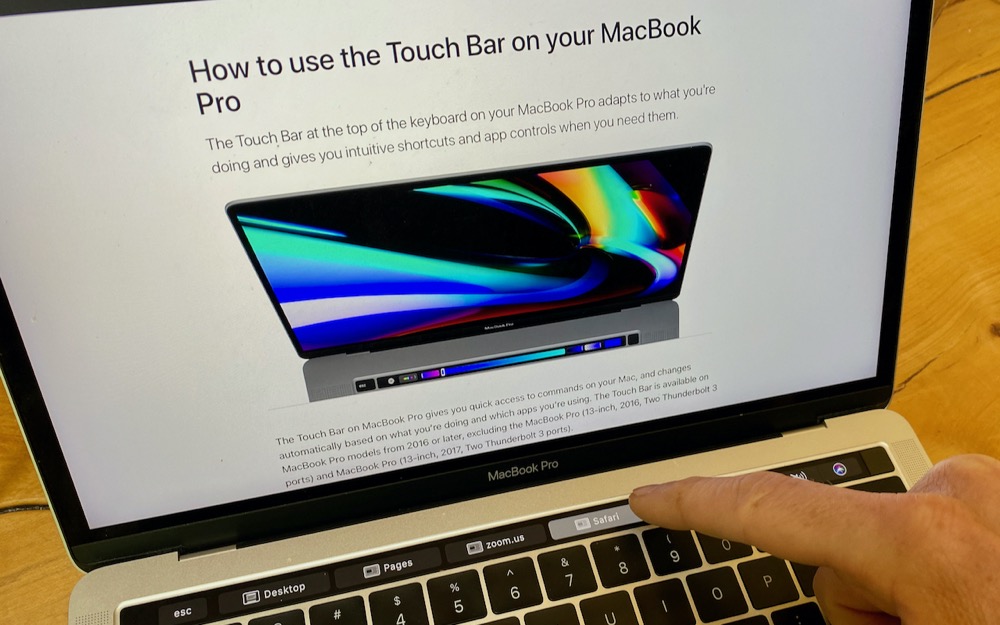
In 2016, Apple introduced the Touch Bar with the MacBook Pro. It's a long, thin display above the number keys on the keyboard that shows a variety of buttons and controls. By default, it changes depending on which app you're in, and it also displays the Control Strip, a collection of controls that roughly mimics the functions accessible from the F-keys that traditionally live in that position. Finally, it includes the Touch ID sensor that brings fingerprint authentication to the Mac.

In a normal year, most kids would be back in school by now. But the COVID-19 pandemic has caused many schools to offer online instruction, and many families are now settling into a remote back-to-school arrangement. We've provided some advice on working from home in previous posts, but what about schooling from home? Here are some suggestions that may help make this transition smoother for both parents and children.

It's inevitable---your Time Machine backup drive is going to fill up. Time Machine is smart about backing up only files that have changed, but after months or years of usage, the drive will eventually reach its capacity. When this happens, you'll need to take action to free up space and prevent data loss.

If you have 20/20 vision or are still wondering why your parents have reading glasses, count yourself lucky. But if you're like many people - over 60 percent of the population by some estimates, including most people over 45 - reading the tiny text on your iPhone or Apple Watch might be impossible without a pair of glasses nearby.

Here's the solution to a problem that clients have run into on occasion. In a workgroup that relies on Adobe Creative Cloud apps, one person might upgrade to the latest versions of Photoshop, InDesign, and Illustrator, whereas others don't. Suddenly, if that person opens and re-saves a file in the new version, those using the old version may not be able to open it, or certain aspects of the file may disappear.

Apple's workhorse desktop Mac, the 27-inch iMac with Retina 5K display, hasn't seen an update since March 2019---nearly a year and a half ago. Happily, the company has finally released a new version of the popular iMac, outfitting it with 10th-generation Intel processors, increasing its RAM and storage capacities, and improving its audio and video capabilities. Prices haven't changed, with the low-end model starting at \$1799, the mid-range model at \$1999, and the high-end configuration at \$2299.

With so many people working from home, lots of attention has been dedicated to making sure everyone has a functional computer, a reasonably ergonomic workspace, and a decent videoconferencing setup. One thing that many have overlooked, however, is the need for a reliable uninterruptible power supply (UPS). Particularly for those using desktop Macs or external hard drives, a UPS is essential because it protects your work---and your devices---against surges, brownouts, and outright power failures. That's especially helpful as we head into the summer thunderstorm and fall hurricane season.
Grove Technologies has been named as one of the world's premier managed service providers on the prestigious 2020 annual Channel Futures MSP 501 rankings. This recognition is a testament to our commitment to delivering exceptional IT services and support to our clients, and we are honored to be included among such an elite group of companies.

The pandemic has forced large numbers of those who are still employed---nearly half the American workforce, by some estimates---to work from home. And while that has actually improved productivity for many people, partly due to eliminating time-consuming commutes, remote work comes with its own challenges. Here are three of the top problems we've been helping our clients solve. Get in touch if you're suffering from these or other tech issues that are preventing you from working as effectively as you would in your office.

Have you ever set up a group meeting, whether in person or via videoconferencing, but found it cumbersome to find a time that works for everyone? Or maybe you want to solicit volunteers for an event? There's a neat online tool that makes such logistics easy: Doodle. You can use it for free (with ads)---even without setting up an account. Or, if you want to eliminate the ads and get support for calendar syncing, deadlines, reminders, multiple users, and more, there are paid Premium plans. You can use Doodle in...
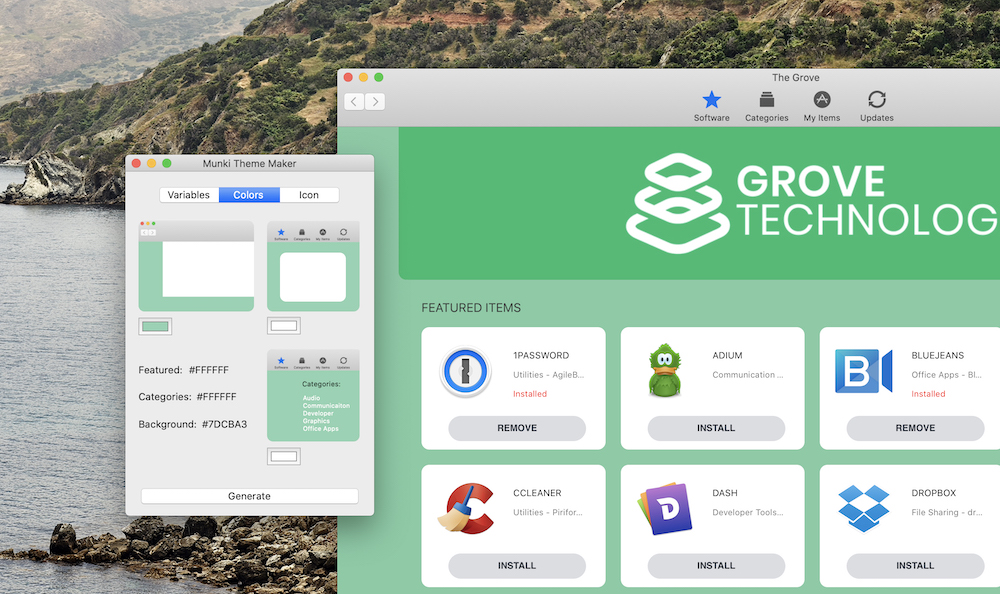
For many Mac administrators in a variety of sectors, an open source tool called Munki, a patch management tool, is more than prolifically used. Our mantra of being a technology agnostic consultancy agency exposes us to a wide range of Mac tools, which we continually evaluate and assess for our clients' needs. Munki is one that we internally have used for years, having found it to be a reliable and effective solution for managing software updates on Mac devices.

At Apple's Worldwide Developer Conference keynote, the company dropped a bombshell: in the future, Macs will no longer be powered by Intel chips but will instead rely on custom-designed Apple chips. As surprising as this is, the company has made such massive transitions twice before: first in 1994 with the move from Motorola's 68000 chips to IBM's PowerPC platform, and again in 2006 with the jump to processors from Intel. Here are answers to the main questions we've been hearing.

Every year at its Worldwide Developer Conference, Apple lays out its roadmap for the next releases of each of its operating systems. The COVID-19 pandemic forced Apple to record its keynote presentation ahead of time rather than having it live, but the company doesn't seem to have tempered its ambitions for macOS 11.0 Big Sur, iOS 14, iPadOS 14, and watchOS 7. In fact, the announcements suggest that Apple is pushing forward with significant updates across all four platforms, including new features and improvements to existing ones.
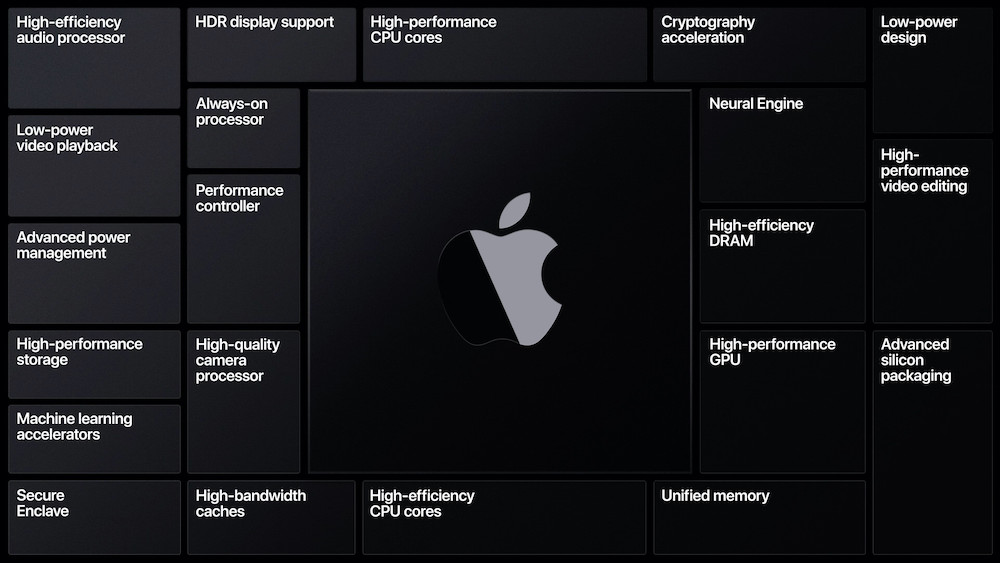
We called it earlier this week saying Apple is likely to move Macs to their own ARM-based processors. Well, Apple has now officially announced that Macs will indeed be available with "Apple Silicon" from late 2020, marking a significant shift in the company's approach to processor design and development.

At one stage around 2009, Pages was actually far superior to Microsoft Word for desktop publishing. However, Microsoft Word has since started to fill those gaps, making it a viable paid-for alternative. Despite this, Pages still offers some unique features that may appeal to users who value simplicity and ease of use.

One of the most significant changes in macOS 10.15 Catalina was the breakup of the long-standing iTunes app into separate Music, Podcasts, and TV apps. But what about backing up iOS devices, which you also used to do in iTunes? In Catalina, Apple moved this function into the Finder. So if you've upgraded to Catalina or bought a new Mac that comes with Catalina, here's how you can continue to back up your iPhone, iPad, or iPod touch in the Finder.

Need help with something? On occasion, we all need tech support. Speaking as the people who are sometimes on the other end of those requests for help, we have some suggestions on how to get the support you need as quickly as possible. We've seen it time and time again: a clear description of the issue can make all the difference in getting your problem resolved efficiently.

It has been touted for several years that Apple may start using ARM processors in their Mac line up. However, in recent months with AMD releasing more and more powerful Ryzen processors pundits have been guessing Apple will announce an ARM based Mac at the upcoming Apple WWDC.

Apple recently released iOS 13.5, incorporating a new Exposure Notification API in response to the global COVID-19 pandemic. We've seen a few people freaking out about this, but seriously, calm down, folks. At best, the Exposure Notification API could lower contact tracing costs, reduce the spread of COVID-19, prevent life-changing health consequences, and save lives. At worst, it won't prove particularly effective. In neither case does it pose any threat to personal privacy.
Have you ever been to the doctor, gotten home, and thought "I forgot to ask about the pain in my side"? Or perhaps you've had a nagging question that's been on your mind but slipped your memory? The iOS Health app will be there to help when the new update hits, providing a convenient reminder system to ensure you don't forget to bring up important topics with your healthcare provider.

We all want Mac laptops that can run for days on a single charge and never need their batteries serviced. Sadly, we're always going to be disappointed. Battery and power management technologies continually improve, but those improvements are matched by more powerful processors and smaller designs with less room for battery cells. And, because physics is a harsh mistress, current lithium-ion batteries are always going to age chemically, so they hold less of a charge over time.

The Mac's ability to listen and talk is excellent using Dictation. Since Siri's launch on the Apple line-up this has eclipsed the Dictation feature.

I'm sure you're already using some of the shortcuts (also known as keyboard commands) in MacOS. For those who are new to these features, or need a refresher, we have an article that provides more information on keyboard shortcuts and how they can be used for common tasks like copy and paste.

It's taken as gospel that Macs are more expensive than PCs. A quick look at the Dell Web site reveals laptops for as low as $300. Sure, we can say that the configurations aren't comparable, that macOS is better than Windows, or that Apple's hardware quality is superior. Still, our friendly local bean counters have trouble getting past those low upfront prices, and it's not uncommon to see them pushing for PC alternatives in budget meetings.

It seems simple enough, but there are some great features, built-in apps, and third-party apps that can really improve your workflow when copying and pasting. These additions may not be immediately apparent, but they can make a significant difference in productivity and efficiency. For example, certain apps can automate repetitive tasks or provide additional formatting options, making the process of copying and pasting more streamlined.

QuickTime is great, but it won't play an AVI file out of the box or the lesser-known MKV for example. And with the introduction of MacOS Catalina, we've had to bid farewell to our trusty old QuickTime 7. This change has left some users scrambling to find alternative solutions that can handle these file types without issue.

If like me, you welcomed Apple's decision to abandon the original 30-pin port in 2012 and adopt the Lightning connector, you likely viewed it as a practical improvement. The Lightning connector is indeed a more user-friendly design, offering a more streamlined connection experience.

So the Tech world's software giant has released a version of its web browser for MacOs again after a 17-year absence. It's actually big news as the last time a Web Browser from Microsoft was available on the Mac it was Internet Explorer 5 which saw the end of a 5 year partnership between Apple & Microsoft where Internet Explorer was bundled with MacOs and was the default browser. This move marks a significant shift in Microsoft's strategy, one that may be seen as a response to changing market dynamics...

If like us you are itching to get into your local Apple store to check out the latest offerings from our favourite tech company, you may be in for a wait. Many customers have reported long lines and crowded stores, making it difficult to get a glimpse of the new products without a significant amount of time spent waiting.

Are you the person your friends and family members turn to for questions about the Mac? In normal times, those questions might come over dinner or at another in-person gathering, such that you could look directly at their Mac to see what was going on. Now, however, with everyone staying at home due to the coronavirus pandemic, answering those questions has seemingly gotten harder. But it doesn't have to be that way, thanks to a built-in feature of macOS that you may not have known about: screen sharing.

We work with lots of businesses, all Mac-based businesses. The biggest point of confusion for many Mac-based small businesses is understanding all the business offerings that Apple has to offer. This can be overwhelming due to the sheer number of options and features available, making it difficult to determine which solutions are best suited for their specific needs.

When you're in the Finder, choosing File \> New Finder Window does, as you'd expect, open a new Finder window. But what folder appears in that window? By default, new Finder windows open to Recents, which is a built-in smart folder showing recently opened documents. If you'd prefer to see items in a fixed location on your drive, go to Finder \> Preferences \> General and choose any location from the New Finder Windows Show pop-up menu. We're partial to Desktop or Documents, but you can choose whatever folder makes...

The necessity of working from home is becoming a reality for many workforce members who may not have had this access before. While remote working offers many benefits to employees, such as increased flexibility and work-life balance, many more risks appear as cybercriminals prey on the lax security protocols of the remote worker. It is critical that we as employees treat this access as a privilege, making security our top concern in order to protect ourselves and our organizations from potential threats.